
Let it be known that I HATE simulated page breaks in word processors. With non-fiction, page breaks don’t bother me. But with fiction, it kills my immersion and gets me thinking about how many pages I’ve written. Not something I want to be thinking about when I’m trying to tell the best story possible, or just trying to belt out a simple rough draft.
I find it much easier to edit and evaluate what I’d written without page breaks getting in the way. These things tend to be massive, over-exaggerated moats, and (in case I wasn’t clear) I don’t like them.
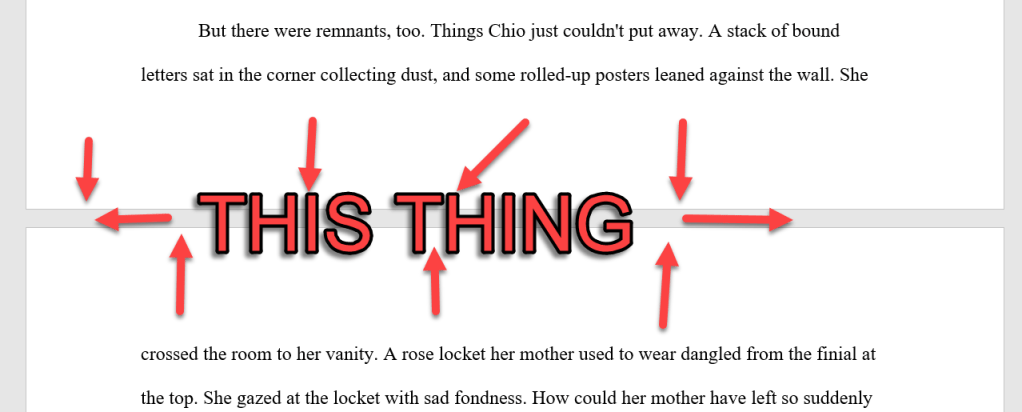
Fortunately, this feature can almost always be turned off, even if the option is buried somewhere deep in a sub-sub-submenu. And once it’s off, I find that my writing sessions last longer. If I don’t know or even care how many pages I’ve written, I’m almost always surprised by how many pages it later turns out to be.
It’s similar in concept to “distraction-free” text editors, which many writers swear by. Some even have timers, making them the digital equivalent of a depro-chamber. I personally don’t like having EVERYTHING off. I like being able to window-jump and do research as necessary. (But distraction-free writing is something worth trying if you’ve never tried it before.)
I also dislike keeping track of my wordcount during writing sessions. I’d much rather focus on real story progress than the number of words I’m typing. Did my scene get further along? Did I complete a scene and start another? Did I complete a story arc? Did I write something awesome? These are the types of questions I’m concerned about. I have a much more enjoyable writing experience when I’m not focused on something as cold and mechanical as wordcount.
When I started writing, I thought it would be otherwise. After all, everywhere I looked, writers were concerned about their daily wordcounts and meeting wordcount goals. And I get it. It’s measurable throughput. But over the years, I’ve tried counting words many times, and I’ve discovered it’s just not a good fit for me. I’d much rather feel great that I finally got past an annoying story speedbump than feel down on myself because I only wrote 350 words today.
And I’m a true convert: Years ago, I used to host a NaNoWriMo-like event called the “Novel Push Initiative”, or NPI for short. It was gaining some traction through word-of-mouth in writing world. But, on my end, keeping track of how many words each participant wrote and logging daily updates (at the expense of my own writing) was soul-sucking. I also saw a lot of participants burn themselves out by bidding lofty wordcounts, such as 1,500+ words per day. …It’s not a good feeling knowing that your event might’ve had a hand in someone else’s burnout.
I’d have a rough time thinking of a phrase more soulless than “measurable throughput”. It’s progress for the sake of progress without the heart. As a data analyst, I see it everywhere. Measurables are being tracked in real-time these days, and they are often being designated the sole decision driver for important business decisions.
The cost for these businesses is tunnel vision at the expense of the immeasurables. For example, the “star employee” who answered the most phone calls and got the fastest “wrap times” may not be giving the customers a pleasant or friendly experience. In fact, it’s highly likely they’re not.
But the algorithm doesn’t care. It hands out digital reward certificates via Email and automatically informs the star employee’s manager to congratulate them in front of their team, and they get digital pats on the back and insincere applause, all helping to further reward this bad behavior. And just like that, the machine rewards efficiency at the expense of heart until the company becomes a soulless husk of its former self.
These days, I feel that writing just one word per day is a laudable goal. Why? Because the biggest and hardest leap from the state of “not writing” to “writing” is actually pulling up your manuscript, finding your bearing, and placing your hands on the keyboard with the intention of adding even one word to your story.
Getting in the habit of opening a manuscript every day is more crucial than meeting some arbitrary goal that might burn you out. And, just like with eating chips, it’s hard to write just one word and be satisfied. So that’s what I do. I write until I’m satisfied with my progress. Your mileage may vary.
 Nick Enlowe
2 thoughts on “Figuring Out What Works: Writing Without Arbitrary Measurables, and How Writing Can Be Like Eating Chips”