
Believers in the philosophy of the caduceus point to prana (“sexual energy”) as being what powers new life. This is part of why it’s linked to their hopes of discovering the secret to immortality.
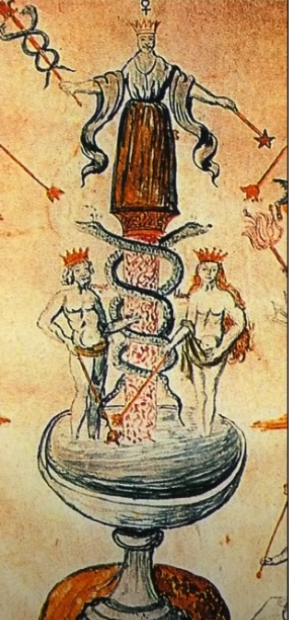
The term “Magnum Opus” (Great Work) was first coined by alchemists who were chasing that ultimate goal. The Great Work is known by many other names: The “cup” in the anja is the Fountain of Youth, the Azoth, the elixir of life, and the Philosopher’s Stone. They are all one and the same.
You may have heard that the Philosopher’s Stone is supposed to turn base metals to gold, but that is an incorrect (and too literal) interpretation, just as the Fountain of Youth didn’t actually exist in a physical location. (Ponce de Leon’s famous expedition to the swamps of Florida may come to mind, but historical evidence suggests him searching for a physical fountain is far more likely legend than truth, not to mention the legend was attached to his story posthumously.)
The true purpose of the stone is to transmute the “lead” of the ego into the “gold” of pure consciousness by transmuting…you guessed it…sexual energy. Like I said, the ultimate goal of alchemy has been known by many names, but its designation has always been a specifically permanent source of water. A “wellspring of eternal life” flowing within the body.

Azoth is the universal cure-all solvent sought after in alchemy, and its symbol going back to ancient times just so happens to be the caduceus.
The idea behind the azoth is a belief that charging prana can heal their bodies. Their proof? Prana created them, therefore it can heal them. And stem cells (which can only be created by “sex magik”, as they call it) are able to heal any part of the body, therefore it is further proof that their beliefs are right. Also, DNA, the very building-block of life, turned out to be structured like a double-helix, just like the caduceus. They don’t believe it a coincidence.
However, I take comfort in knowing their attempts at immortality have thus far failed. Stem cell research is merely the modern incarnation of alchemy, but we are all still mortal and die in the end. Their secret knowledge hasn’t elevated them above the rest as far as they’d hoped.
But this does help explain why the U.S. so readily adopted the caduceus as their medical symbol. Many of the highest offices in U.S. medical institutions are not after cures, they’re after treatments. They’re not here to honor the Hippocratic Oath, they’re after the Philosopher’s Stone, and believe stem cell research and cloning can get them there. Make no mistake, many of the people in charge of medicine today are not doctors and researchers, they are modern-day alchemists.
 Nick Enlowe
4 thoughts on “Unraveling the Many Secrets of the Rod of Caduceus: The Philosopher’s Stone”