These days, I have very little trouble getting over my wall and getting started on (or continuing) a project. I’m able to mentally prepare myself for such a task fairly quickly, and if I can’t do it on my own, urgency goes a long way in helping me scale that wall every day, ensuring I work on the project on a consistent basis. That’s one reason why hard deadlines really help.
But, if there’s no deadline and it doesn’t feel urgent, I’m less likely to bother with the Wall of Awful on a particular given day. No one likes facing the wall.
As I’ve gotten older, I’ve found ways to reduce the number of bricks in my wall by forgiving myself for some of my past failures, or deciding not to care so much about what other people think. Easier said than done, but holding onto this mindset for years and years does make your wall easier to scale.
Once I’ve scaled the wall, another impediment stands between myself and getting it done if it’s a huge task (with no deadline and low or no stakes involved). This is known in ADHD circles as “Motivation Bridge”.
THE BRIDGE
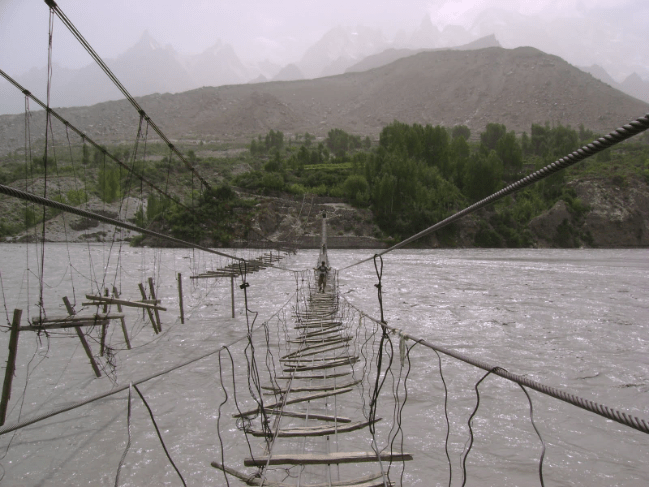
Someone like me can have all the intention in the world of doing something. Feel it in their very soul. But we have to cross this bridge to complete the task. The larger the task, the wider the gap. Falling into the ravine represents failure, the nothingness of never getting done, what it looks like to give up, or it could even represent death.
The planks across the bridge are built with expectations for yourself, other people’s expectations, the benefits of completing it, etc. For most people, there are enough planks that there’s only small gaps in the bridge that can be overcome with enough willpower and self-discipline, especially if it’s for the greater good of their career, their grades, etc. They might have trouble getting over the bridge, but they’re probably not going to be stuck on it for many years.
People afflicted with ADHD tend to be missing more of these planks. A lot more. Often, half the bridge is missing. Clinical psychologist and “ADHD expert” Dr. Russell Barkley refers to ADHD as a “motivation deficit disorder”. Perhaps I have “MDD”, to a certain extent. I do seem to lack the motivation I need. But, like I said, I want to avoid labels. Even made-up ones.
If there aren’t enough planks for me to leap across to the next planked section of the bridge, I can look pretty darn pathetic to someone who can make it across time and time again. Most other writers simply can’t relate and give me the awful “Top 10” advice that simply doesn’t work.
These people can’t see my missing planks. They can only see their sufficient number of planks as if it was their own bridge I’m dealing with. Since they’ve projected their planks onto my bridge, they can’t see why I’m struggling so much more than they did.
And I understand. It can be frustrating watching me try to cross. They’re not sure why I don’t just do the thing. They may even shrug and say, “Just write”. Maybe they’ll even refer to that famous scene from Finding Forrester.
I answer, “It’s not that simple.” And they assure me it is. And, who knows? Maybe they’re right. But I seem to require a more nuanced process than that. The human brain is fickle and complicated, and no two authors have the same process for a reason.
At any rate, if crossing my bridge starts to take an inordinately long amount of time, an outside observer might think I’m being lazy or that I just don’t care enough. But I know I care enough. That’s not part of my problem. And actually, this can create a plank. The “I’ll show you!” plank.
Telling a family member how important it is for me to finish my novel doesn’t do much good, either. It doesn’t help me get any further, and they already know it’s important to me. They’ve seen me struggle, and they support me. That does help, adding another plank. But it’s far better to show them it’s important to me by writing every day.
What does a good writing day look like for me? Well, it’s a day I managed to swiftly get over the Wall of Awful (despite a lack of deadlines) and onto the bridge. But, even then, I still can’t reach the other side without filling in enough missing planks. And, as you’ll see, urgency goes a long way.
People with … MDD … need a different set of planks to reach their end goal than a typical person would.
According to various studies, things that are urgent, things that are new or novel, and things that are “stimulating” help fill the gaps to reach the goal.
I often have to get creative in order to make my gap more crossable, and, sure enough, my solutions usually land in those three categories. I try to make the trip with armfuls of extra planks such as…
- “There’s a hard deadline!”
- “There’s consequences if I fail!”
- “I’m doing it for a friend.”
- “My kids will love it!”
- “If I don’t complete this, people will be disappointed in me.”
- “If I fail, I’ll be disappointed in myself.”
- “Hey, this new writing software is cool!”
- “Maybe I’ll write outside today, under the tree!”
- “Gamification!”
- “I’ve been writing consistently lately, and I want to continue my writing streak.”
As stands, I’ve amassed enough planks to make it about 30,000 words into a story, and I’m always on the lookout for more planks to make this journey over wider gaps.
The reason people like me tend to retreat to video games is because they’re absolutely littered with the kinds of motivational planks an MDD mind is hungry for, and it offers heaps of instant gratification, triggering dopamine responses.
Let’s say such a child needs to do a book report, due in three weeks. Guess what? It’s almost three weeks later and they’ve procrastinated, playing video games each night instead. The motivational planks simply weren’t there for them to get much momentum on the book report, let alone read more than one chapter of the book.
Then, the day before the book report is due, a whole slew of motivational planks get added to the bridge. Suddenly, getting the paper done is urgent. “Turn it in or get a zero,” the teacher said. Another plank or two, for sure. The child is now speed-reading and checking online summaries, trying to feverishly stitch together a convincing paper.
The child had trouble knowing when to get started and had issues staying focused … until it was crisis time. Suddenly everything cliqued and a paper was born. Not his best work, but at least it’s done.
This is why artificial deadlines don’t work for me. On some level, I know the deadline isn’t real and that there’s no concrete consequences … except for maybe one more failure brick tossed on the already giant Wall of Awful standing before me when I inevitably fail to meet my self-imposed deadline. Without some form of accountability, deadlines are useless.
That’s also why I don’t use wordcount goals, but scene goals. Completing a scene is concrete. I’ve joined writing groups that have you report your daily or weekly word counts, and writing 700 words a day can look very different from one person to the next. Chances are there’s a lot of “creative accounting” going on behind the scenes to fudge numbers … from all the members. But you can’t fake a completed scene. That’s real story progress.
In conclusion, people with brains like mine have a hard time without real accountability for our deadlines. Have you ever had a laid-back teacher or boss say something like, “It’s okay. Just get it to me whenever.” Those words, while they seem friendly, actually remove planks. It all but guarantees the student will never turn in the work, although they might still try on the very last day of school (Yes, I’ve been there).
FINDING BETTER ANSWERS
Procrastination solves all the problems … in an unhealthy way. With the example of the student, they waited until the day before the paper was due, so they suddenly know when to start: RIGHT NOW.
They have no trouble staying focused, because the deadline is Monday morning, when class starts. That ever-looming deadline creates pressure. It’s enough of a motivator to get them through the project.
And they also know when to stop: as soon as they have a paper worth turning in. It doesn’t have to be perfect. It just has to be good enough.
Assuming nothing goes wrong in the last minute (which it often does, such as no printer ink, paper doesn’t get saved, etc.), and the teacher fails to realize the kid didn’t actually read the book, the kid is in the clear, and it teaches them to procrastinate again next time.
Did I mention people like me tend to not know when to stop an activity once we get started? We often get “time blindness”, not realizing how much time has passed while we get lost in the YouTube algorithms, work on a project that interests us, or play a video game. Also, we tend to be perfectionists. Procrastination solves all these problems. But it only works if there’s a hard deadline with some form of accountability involved.
That student waiting until the last minute sounded a lot like me through grade school and high school…and early college. But now-a-days, if I’m given a hard deadline, I’m much more disciplined and organized. I work on the project periodically until it’s done. I’m enough of a perfectionist that I like to put a lot of effort into a project and make it good. And, at some point, I realized how unhealthy procrastination is while under a deadline. That’s … not a thing in my life anymore. But problems remain.
- I must unlearn perfectionism.
- I must learn how to not procrastinate when there’s no deadline.
- I must learn how to work without a deadline.
Perhaps I can view a large project as if it were in smaller chunks. If I can bridge the 30,000 word gap, why don’t I split my novel into three chunks and write them as if they were their own trilogy?
And, if nothing else works, remember when I said it’s impossible to go under or around the wall? Remember when I said it’s not possible to jump the large gaps between the planks? Well, a little prayer can go a long way. Miracles can happen.
 Nick Enlowe
One thought on “The Bridge”