
On July 22nd of last year, I boldly proclaimed Silence is a Rabbit Hole. But what was I getting at, exactly?
By the end of the aforementioned article, I’d posted a confusing little comic page layered with esoteric meaning, promising to revisit it once we explore some of what that artist was trying to maliciously hide in plain sight.
And explore it we did. Over the months that followed, we discovered the esoteric meanings behind the world that surrounds us, from who and what the Statue of Liberty really is to how the Rod of Caduceus maps to just about every world religion. We learned how this rod relates to lingams, Hermes, the Philosopher’s Stone, Prometheus’ torch, the fountain of youth, psychadelics, and the chakra, among other things. We learned how it maps to the twin pillars, the Luciferian lightning bolt, and the Sephirothic and World Trees. And I could go on. It’s the ultimate, never-ending iceberg, really.
After dragging my readers through this unpleasant journey, I touched on how all this relates to writing, asking questions such as why and how so many successful writers know about this stuff, and why it keeps reappearing in popular published works, hidden in plain sight.
It’s a tough lesson, but religions tend to be a reskin of this core idea that one can unlock their “true potential” either through unchecked lust or through the delayed gratification of lust; A focus on self-“empowerment” by controlling or letting loose their repressed lower animalistic instincts and desires. And quite often, it focuses on the manipulation of others.
The high priests offer this superpower as a temptation, a shiny apple of forbidden knowledge, the gateway to magick and greater understanding, as a shortcut to “wisdom” (and rather ironically and unapologetically call it wisdom when it’s anything but). As we learned, there are no shortcuts to wisdom.
Time and time again, I find that these religions focus on eros while diminishing or outright ignoring the other forms of love: storge, philia, and agape. (Of course, they “love” the opposite of philia, which is phobia and use it as recklessly as possible.) Heck, the English language rather deviously compiled all the loves into one word, as if they’re all one package deal. No wonder U.S. pop culture focuses so heavily on messages of love for the sake of love.

Spend enough time with these religions and, sure enough, in slithers the serpent, just like how the serpent reared its ugly head in the Garden of Eden.
There’s a convincing illusion of choice if you don’t look too deeply, but they are ultimately a means to the same end. Heck, even the featured gods in these religions are more often than not reskins of older gods. It’s like they have no originality at all.
I’m reminded of being at the grocery store thinking I have a choice between brands, only to discover that nearly every brand I’m looking at is owned by the same parent company.
ANALYZING THE COMIC PAGE
Having explored the darker side of this world, we’re ready to go into full-on analysis mode. Let’s take another look at this comic, shall we? What mysteries shall we unfurl? (Again, this is from Alan Moore’s Promethea, published in 1999.)
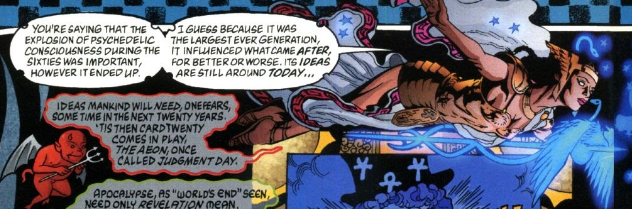
The girl flying through the cosmos is the title character, Promethea, who now wields the Rod of Prometheus and has basically become the female embodiment of Prometheus himself because she really, really wanted to (and was writing a school paper about it–I wish I was joking).
So right-off-the-bat, we have a gender swap. And according to the story, anyone who wants to, badly enough, can become the next Promethea. The story even gives accounts of passionate poets, writers, and artists who slaved over works devoted to Promethea and managed to summon her…or even become her. (I’m sure Moore worked very hard on this story, by the way.)
Perhaps you can now spot the intertwined serpents and the wings of Hermes (on the staff she wields, colored blue-violet in this picture). And of course the wings on her helm also represent the Wings of Hermes. By this point in the story, she’s already gotten plenty of free unearned powers, and she is now attaining further enlightenment to throw even bigger fireballs at Evil Men, and other monstrosities that literally want to rape her.
This particular issue is about guiding her through the “History of Magick”. But who’s leading her on this guided tour through the mind’s eye?
You may notice the darker dialogue boxes come in two different colors. Those are the twin snakes speaking to her, Ida and Pingala. But in this case, they’ve been renamed to a more friendly-sounding “Mike” and “Mack”. Palette-swaps, disguises, and modern updates abound. I’m sure they were renamed to seem more approachable. More trustworthy. More human. More charming, as snakes like to be.
You know what else is charming and makes insufferable infodumps more palatable, friendly, and approachable? Poetry. Speaking in cute little rhymes.
Do me a favor: If you ever come across an ancient magical being who claims his name is “Mike” and he’s not an armed and righteous angel, be suspicious.
So, this poor girl is in the process of being indoctrinated. She was just told about the hippies, and how tragically naive they were.
Here’s some of what the snakes told her on the previous page, leading to her response:
With World War II, factors converge
(Wealth, science, a demographic surge).
Youth, by the century’s middle years
Outnumbers age, seeks new ideas.
Buddhism, zen, astrology,
And the I-ching mixed randomly
With drugs which aped the shaman’s trance
Into the decade’s cultural dance.
This was a psychedelic peak
(Or “soul-revealing” from the Greek).
Youngsters, still wet behind the ears,
Took on the roles of bards or seers.
Alas, the zeitgeist’s solar flash
Scorched most such visionaries to ash.
Their lives, confused, addicted, lame,
Drugged melodramas now became.
So the youth in the 60s were naive. What does that have to do with “magick”? Well, remember, the art of the magus is to lie and lie some more. The philosophers in charge saw a unique opportunity: They were able to use this generation’s tragic naiveté to their advantage. So they lied through the TV and music and school programs to the youth about how good they had it, about how they should feel about their parents, about what they should like and who they were meant to be, and many other things. The irony is, Alan Moore was trying to do the exact same thing to Gen Y youths through this very comic.
Moore, of course, is also a magus. He wanted to dangle juuust enough carrot to invoke curiosity. Offer leads here and there without being too suspicious to nosey parents, and without revealing the ugly flipside of the coin to the reader. Like how he namedrops the I-ching, or how he so kindly defines what the word “psychadelic” means. He’s clearly aiming at a teen/preteen audience, hoping to add some occultist wrinkles to their plastic, malleable brains.
But he’s right. About the hippies, I mean. I’ve taken digs at the boomers a few times myself, but I especially loathe the hippies, the dumb-dumbs who were roped in by shysters such as Carlos Castaneda (Please check out author Brian Niemeier’s excellent blog post about Castaneda).
Even Moore knew bringing about the supposed Age of Aquarius through the boomer gen could backfire. There were too many twits running around naked in the desert using drugs and meditation, seeing things they didn’t understand. This sort of thing results in a certain amount of chaos (much to the delight of Chaoticians). Hence Promethea responding by saying (of the hippie movement and the sexual revolution), “It influenced what came after, for better or worse. And its ideas are still around today.”
The point is, Moore wrote this comic in 1999 and knew the boomers were used for social engineering experiments, that it related to the occult and magick, and as you’ll see, he knew exactly what that could mean for the future…and welcomed it with open arms. In fact, his comic wouldn’t have been possible in a more moral and well-adjusted 1999, so he should be thanking those hippies. The internet back then wasn’t what it is today, and occult information was still fairly well-guarded. Moore had a teacher tell him these things, likely at the cost of his soul.
Of course, while priming Gen Y for the occult in this story, he couldn’t help but take digs at Christians as often as possible. In the first issue alone, I counted three times. For example, Promethea’s father was killed. So of course:
“A Christian mob killed him…
-Promethea, issue 1.
Not uncommon back then.”
Why not just a mob? Why even mention the “Christian” part? It doesn’t have much to do with the story, but it has everything to do with theme. The story never stops to ask intellectually honest questions such as, “Did he deserve it?” (He totally did, btw.) All that matters in that scene is a little girl is crying because daddy was taken away by the evil Christians (Apparently that’s what they “commonly” do: Gang up and leave helpless orphans in their wake), and now she wants (deserves) revenge. This kind of cheap strawman writing causes emotional triggers that love to burrow in the back of impressionable people’s minds and resurface thirty years later. That’s magick. That’s how it works.
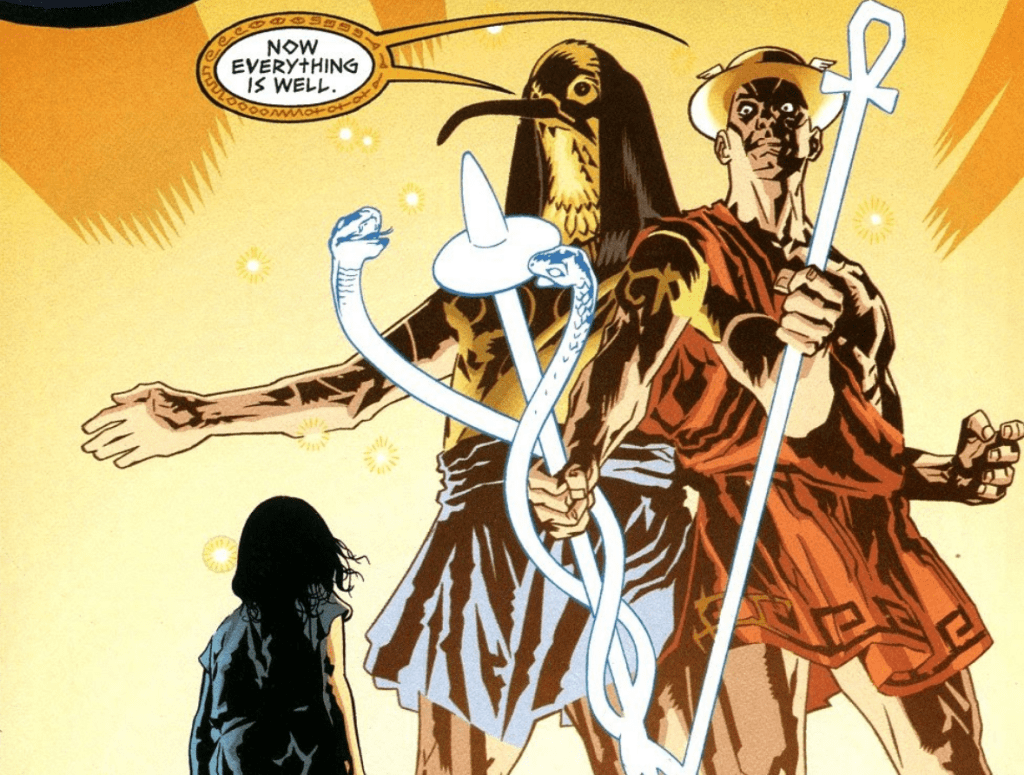
But I admit this set of circumstances wasn’t entirely the boomers’ and jonsers’ fault. They grew up in a more innocent world. The pop culture gods used that to their advantage, programming the youth to guide the future. Do you think the kids all just woke up one day and decided to do drugs and tantric yoga? Well, the rest is history. And it’s also our rapidly approaching future. For better or worse.
I’m sure you’re dying to know what Harpo Marx, of all people, is doing in this comic. Perhaps it has something to do with the magick of silence? More to come.
 Nick Enlowe
8 thoughts on “What We Can Glean from the Rabbit Hole”