
I’ve been putting off this series of blog posts for a long time.
It’s easy to forget I actually have a reader or two, so when one reaches out to me and tells me they still check my blog every day, I can’t help but feel humbled, flattered, and feel the need to deliver.
So today we’re revisiting Promethea, picking up on our journey to explain why silence is a rabbit hole.
Where we left off, the titular character was in the middle of being indoctrinated by the twin serpents Ida and Pingala. The snakes were using cute little rhymes so as to cloak their ideas as harmless, non-threatening, and innocent.
They almost lamented about how New Age ideas were foisted upon the naive youth of the sixties, potentially to great disaster (although this was also said with some measure of glee). The hippies, after all, missed the plot entirely, boiling down third-eye psycho-trips into a simple “stick-it-to-the-man” druggie subculture rather than discovering the “deeper meaning” they were supposed to. Even when bad actors wrote books to steer them in the right direction and tell them exactly how to think, and even as yoga studios sprung up in every small town across the United States, the deeper meaning is still lost on them. Thus they have become idiots. Useful idiots. Ida continues:
“Ideas mankind will need, one fears,
sometime in the next twenty years.
‘Tis then card twenty comes in play,
The Aeon, once called Judgment Day.”
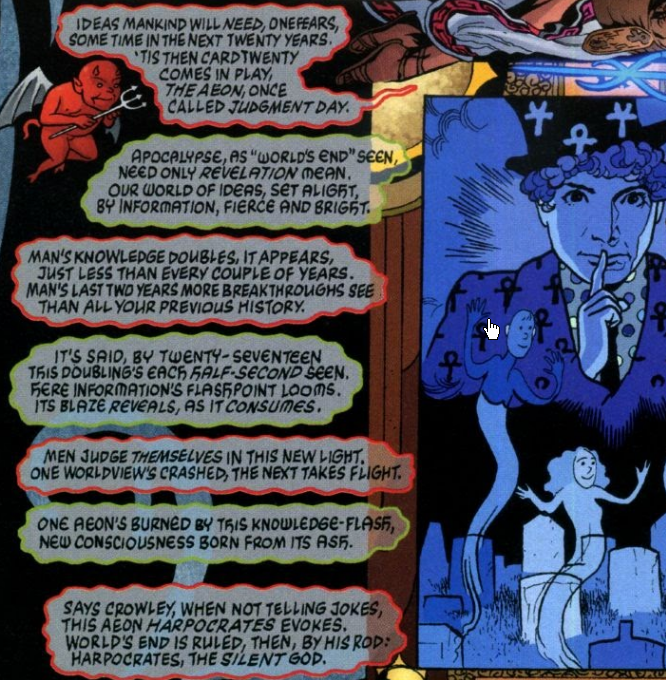
I should remind you that Promethea was published in 1999. So Moore was playing the prophet, saying that by (roughly) 2019, the hippies will need the ideas they’d learned from their “enlightenment” to help mankind survive the upcoming Judgment Day. Yes, according to this passage, our future rests in the hands of a bunch of blitzed-out, deadbeat druggies.
And this prophecy has become true. Just look at who has taken over academia. Look who took over the government, the arts. Look who’s been making movies. Look at who’s been influencing children, and in almost every case it’s being done in the same manner that these twin serpents are coiling around this young girl’s mind.
The hippies were misled, and so was she. She’s been given new ideas by bad actors who purposefully omit the devious undertones. She’s being told of a whole new world with just enough context to make it intriguing–to tempt like the serpent did in the garden–but with enough context held back as to not be asked too many questions. They present their ideas as a shiny red apple from which to take a bite.
So who, or what, is this “Aeon”? We’ll address that later.
 Nick Enlowe
4 thoughts on “Devious Poetry (part one)”