
Creative writers aren’t at risk of losing their jobs to AI anytime soon. And the old “1,000 words” saying may be the reason why.
Is a picture worth 1,000 words? Well, let’s be fair: A picture could be worth a scene of words, which would likely land the wordcount anywhere from 700-1,500 words, especially if the picture is trying to convey some kind of story beyond, “Hey, look at this pretty place.”
It will likely be depicting a single moment within a scene, or maybe just the scenery, which could reduce the wordcount to a really dense paragraph or two. Still, that’s a lot of words conveyed all at once. Every word can be unfolded and unpacked into synonyms and feelings in the viewer’s head, expanding the number of words several-fold.
A good painting (one that comes alive, springing forth with a wealth of detail and untold stories, a painting that suggests the world expands beyond its borders) can communicate a whole novel’s worth of information to a viewer within the span of a few moments.
If viewers should take the time to study any painting closely, they’ll start to notice the smudges, the little imperfections, but all one has to do is step back to get out of the weeds and enjoy the picture as a whole. The brain does a great job filling in those lost, missing, or fudged details when its taking in so much information at once. It can add information to help you make sense of the image, filter out unnecessary information, smooth out unreality, and even invent patterns where none actually exist.
Now, if the image has one large, glaring error, such as significant damage to the canvas, an extra appendage, or eyes that seem soulless, it breaks the suspension of disbelief and the brain focuses on that one problem. Fortunately, “AI artists” can solve those glaring issues by using techniques such as “inpainting” and “photobashing” in order to make their work a viewing experience more akin to the previous paragraph.
I believe this is part of why AI art developed so quickly, rapidly outpaced writing AI, and is now taking the world by storm.
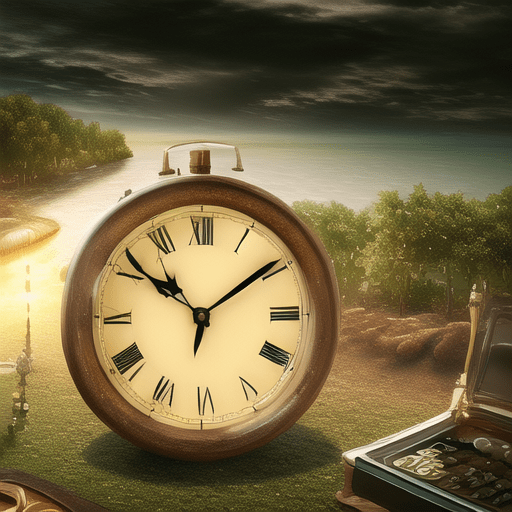
The image from my previous blog post was generated AI art, and no post-processing was used to fix any mistakes. You may now start to notice the imperfections, such as missing roman numerals and other such oddities.
Writing AI has a much bigger challenge ahead of it. Reading an output performed by even the most sophisticated writing AI can be moderately impressive at the micro level, but it will soon (and often does) show its warts.
To reiterate, the way a reader experiences a story is essentially by standing too close to the painting and slowly backing away from it. Right away, you’re going to notice many of the tiny problems. After all, you’re not taking in 1,000 words in a single moment, you’re taking in just a few at a time.
The brain can help fill in some missing words and ignore spelling errors in order to help make sense of the story, but only to a certain extent. It can only do so much heavy lifting before it wants to check out. Writing laden with a minefield of errors certainly doesn’t make for a smooth, easy read.
It’s up to the human writer to notice all these problems and edit manually. Which takes skill. And not just any type of editing, we’re talking a comprehensive nuke-and-rebuild in most cases, because you’ll find there’s so many peculiar oddities that you’d have likely been better off writing the passage from scratch. Re-genning the passage over-and-over again is possible, but it can only get you so far.
Since stories are experienced by readers in this zoomed-in state, writers can’t easily get away with fudging details. That’s one of the main challenges of being a writer: Readers go over your work with a fine-toothed comb because that’s the only way to experience a story. They’re only able to step back and appreciate what you’ve written as a whole once they’ve finished it. If they finish it.
On a micro-level, they can “step back” from a description, from a scene, and from a chapter, only to zoom in again and start anew. Each time they like what they see, they’re likely to continue turning the page.
Why is it that AI Art is Rapidly Outpacing AI Writing?
Images have what’s called “dense representation”, while text has “sparse representation”. Thus, it’s far more likely that two neighboring pixels will share information with each other than two neighboring words.
Take into consideration that AIs–and this is true even for the most sophisticated AIs on the planet–do not fully understand nuance and have trouble storing more than the previous 2,000 words into memory. By the time you reach the end of your novel, it won’t remember who half your characters are, the meaning behind the social mores you’ve invented, the emotional journeys your characters have been through, or how your story began, let alone all the stuff that happened in the middle.
Without the context, it’s not easy for an AI to understand the whole situation of what’s going on in order to expand upon a story, whereas filling in missing pixel data with gradients, lighting, shadows, bumpy textures, and color approximations is much easier for AI to achieve convincingly on a virtual canvas, the faults of which can slip right past a viewer.
This difficulty goes double for fiction, as expecting the AI to be creative and deterministic while moving forward rather than trying to “fudge it” is asking for a lot more computational power than Moore’s Law currently allows.
But not all’s lost – Writing AI is at the point where it’s quite good at writing blog posts, facts, tutorials, term papers, and other…boring articles…because there’s very little creativity involved. It doesn’t need to understand deeper meaning or how to deliver clever and witty meta-dialogue in order to write an article on current diet trends. All it has to do is sniff out and relay information while keeping track of what it’s already shared, then wrap it up with a nice, conclusive paragraph. Most term papers conveniently fit within that 2,000 word memory limit as well.
But if you’ve ever tried putting an AI through its paces with a complex work of fiction, you probably know exactly what I’ve been talking about.
And don’t worry, this blog post wasn’t some big “gotcha” where I reveal it was written by AI at the end. I wouldn’t do that to you.
 Nick Enlowe
One thought on “A Picture is Worth 1,000 Words”