One of the biggest excuses in the procrastinator’s toolkit is a strive for perfection, endlessly editing and re-editing until what we’ve written is “perfect”.
I was guilty of that. At the very least, I’d try making what I’d written bulletproof against most criticisms. The more bulletproof my writing was, the thinking went, the more confidence I’d have in publishing it.
And once it was out there, the words were practically set in stone like an epitaph, so I’d better get it right. Perfectly right.
Of course this mindset is torturous in that even a single paragraph can take months to perfect. Before you know it, you’ll have shelved a manuscript you once felt passionate about, but now let sit unfinished for 10+ years.
By far, the worst part of this mindset is the more time you spend on a piece of work, the more it hurts when it’s not well-received.
There’s always something to criticize. Even chapters I thought I’d polished to a perfect sheen rarely came out of a critique unscathed. Meanwhile, some short story I belted out in one sitting got little criticism and was showered with praise.
It was a tough lesson, especially for me. When I was a kid, my mother would go on and on about how she wanted everything to be perfect, how she wanted us to behave perfectly, how our hair had to be perfect, and she’d micromanage my sibling and I until we fit her definition of the word, painful grooming and all.
If we behaved as anything less than “perfect little angels” in public, we’d get an earful about how embarrassed and disappointed she was during the car ride home.
I’ve grown to believe the word “perfect” is unhealthy, so I try to avoid it in front of my children.
In time, I discovered it’s an impossible standard to achieve. Even if you think you’ve done something perfect, there’s always ways to improve it, and there’s always going to be someone out there who disagrees with your assessment.
The Worldly Taint
Even if it seems like everyone agrees that what you created was perfect, that doesn’t mean it will always hold up to that standard. We can only be so prescient. Standards change. What is inoffensive and completely innocent today may be offensive tomorrow.
But it goes beyond that. I wasn’t being hyperbolic with the title: Perfection actually is a sin.
The only being that can create perfection is God Himself. We live in a fallen world, so by its very nature, anything we create will share at least some of its worldly taint.
It is good to create works of beauty that strive to reflect and point toward the glory of God. But for a human to believe he has achieved perfection, something only God can do, is heretical.
The only thing we can hope for is near-perfection, guided by divinity. But in most cases, all we need to do is strive for “good enough”.
I don’t aim for perfect anymore. During the final stages of editing, I aim for “professional level”.
Most perfectionists don’t even think about God. Instead, they tend to look at the mundane world, at their past failures, and try to anticipate audience expectations.
If someone like that does manage to create something most agree is “near perfect”, it often creates a sense of elitism and hubris. Exclusive awards are passed out, backs are patted. The glory meant to be pointing toward God gets redirected instead toward the glory of the artist.
But now, you have to follow it up. You’ve set the bar awfully high.
Michelangelo’s Struggle with Perfection
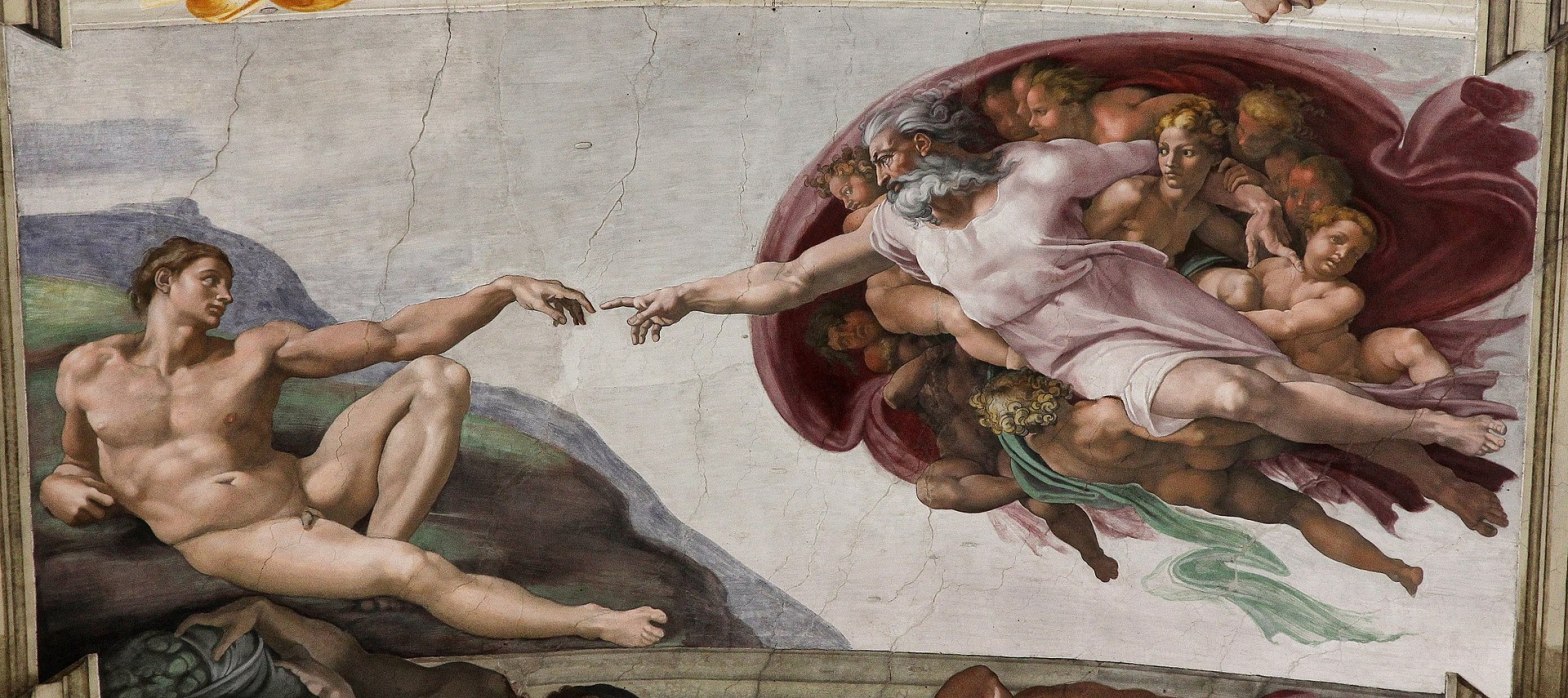
When Michelangelo was commissioned to paint the ceiling of the Sistine Chapel, he was told to paint the twelve apostles inside twelve triangular panels. But Michelangelo convinced Pope Julius II to let him paint one more work of his own choosing in the central panel, which he billed as a representation of the “Creation” and “Fall of Man”.
The Pope probably shouldn’t have agreed to this–Michelangelo was a known radical who disagreed with Catholic traditions. And, sure enough, central to those twelve apostles, arguably the most famous fresco in the Sistine Chapel does contain several radical departures from Catholic teachings.
For example, his piece suggests Adam and Eve were created at the same time (God has his arm around Eve, while Adam’s rib is still unremoved), that souls are pre-created (there are many pre-created humans behind God in Heaven), and some interpretations of this painting even suggest that God Himself gave birth to Adam rather than created him (due to the “uterine mantle” surrounding God, and the green sash representing an umbilical cord).
It took Michelangelo four years to complete the commission, and he was frustrated at the time. This was because he’d been striving for perfection while working on another commission: the Pope’s tomb. The tomb was only supposed to take five years to complete, but he worked on it for forty years. And even after all that time, it was never finished to his satisfaction.
That’s the other part of this lesson: We’re our own worst critics. If any of us were to set foot in Pope Julius’ tomb, we’d doubtless find the artistry surrounding us stunning. All the imperfections Michelangelo could see, we cannot. Or at least, even if we did manage to scrutinize it enough to find some faults, we would likely forgive those to appreciate the whole and enjoy the greater experience.
Now, let’s shift gears to movies for a moment: Think of the endless unnecessary revisions to the original Star Wars films.
Sometimes, an earlier draft is better, and the artist–in pursuit of perfection–meddles with what should have been a finished product to its detriment.
“There’s something I need to–I should probably tell you before-“
-from the movie Fanboys
“Before I’m gone? Man, you can say it, I won’t hold it against you.”
“I just, I wish I could change these last three years, you know?”
“I wouldn’t want you to. You gotta keep the flaws. Crappy effects, real puppets. That’s what makes it so good, you know?”
Which brings me back to the painting at the top of this post.
I don’t want to downplay one of the greatest artists of all-time. He left a legacy upon this Earth like few others due to his hard work ethic and God-given talent. But even his work wasn’t perfect.
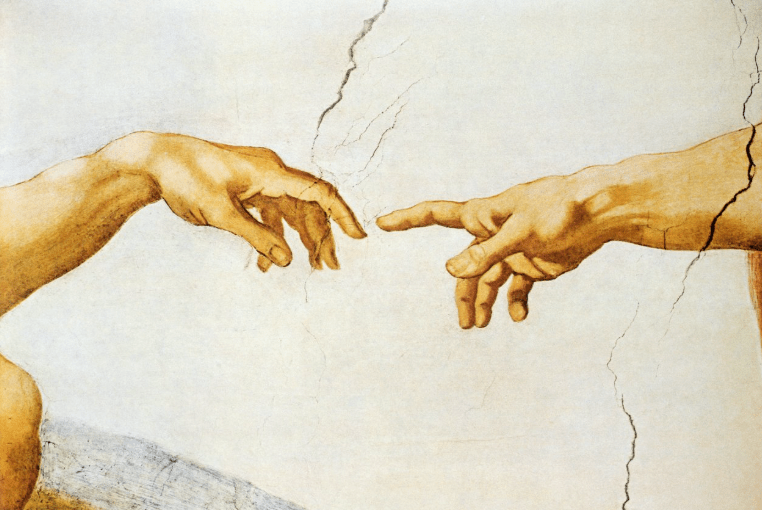
Michelangelo knew this and was frustrated by that fact. Perhaps he had the hubris to believe he was close, so close, he could almost touch the hand of God, mere centimeters away.
But had Michelangelo not been such a critic of dogma, perhaps he could have seen the beam in his own eye and realized he was holding himself to a standard that was not only impossible, but costing him his own happiness.
 Nick Enlowe
2 thoughts on “Perfection is a Sin”