
Bashing Catholics on social media seems to be the one thing that protestants, athiests, anti-Catholics, and many other denominations can agree upon, and they do so gleefully.
It’s sad to see people I otherwise respect post things so hateful, so vitriolic, so full of pride. They seem certain Catholics are damned due to the idolization of Mary. And they have so much fun pointing this out that one wonders if they’d be interested in learning our side of the argument. Most of the time, the answer is a resounding no.
But it’s clear to me that a lot of folks need help with this topic, and maybe someday one of them will happen upon this blog.
Let me state that I am not a trained Theologian, nor was I raised in the faith. Furthermore, I was never trained in apologetics. These are simply the answers I have come across in my studies, in my walk with God.
So first things first: Catholics don’t worship Mary. Never did. They don’t idolize her, either. If I ever set foot in a mass where they were actually worshipping Mary as if she were some kind of goddess, I would immediately leave–I’m talking run–and report them as a heretical church.
But that’s never happened. I’ve traveled all over the U.S. attending masses, and even attended some in foreign countries. Even the oddest, most unorthodox among them never hinted at doing what Catholics are being widely accused of in social media circles. I’ve never witnessed a Catholic priest worshipping Mary, and I’ve certainly never seen a sacrament or offering done in her name instead of God’s. If it is happening at all, it would be in an uncatechized church who has a gross misunderstanding of Catholic beliefs (which would make that church not Catholic by default).
The first time I heard this Mary worship argument, it didn’t come out of left field for me. I was raised in and out of various denominations and my parents experienced faith in many phases. I’ve heard this idea spoken about by Mormons, Jehovah’s Witnesses, and many other groups.
So I had heard the rumors that Catholics “worship” Mary, and I understand what the Catholic church can look like to a layman constantly surrounded by said rumors. It can make one a bit nervous even setting foot inside a Catholic church, and I think that’s exactly what these rumors are designed to do.
But to a lifelong Catholic, they tend to think, “Protestants really believe that?” It’s such a ridiculous notion to them that they have to scratch their heads and wonder where the idea even came from.
It’s like when foreigners have this dramatic misconception about your country. Something that’s so wrong, so off the mark, that it’s hard to know where to begin let alone how to set them right, other than having them come visit and see for themselves.
Wherever this nasty rumor originated, I believe it was done as a calculated attack against Christianity as a whole. Another way to splinter God’s people. Divide us, turn us against each other. And it’s working.
No Secrets
Catholics do not hide any aspect of their beliefs. That’s one crucial thing that attracted me to this religion over all the others. The exact way Catholics interpret the Bible can be found in the Catechism. It’s all there and widely available.
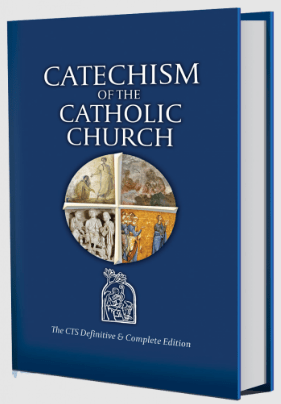
What Catholics believe is not something only select scholars who pass various levels of tests learn from a tutoring priest in an ivory tower behind closed doors, nor through a secret society after proving yourself by climbing the ranks, nor discovered after completing a pilgrimage that involves scaling a mountain to reach a hidden temple full of monks.
It’s all laid bare. If someone is serious about learning what Catholics actually believe regarding the Virgin Mary and everything else, reading the Catechism would clear every misconception.
It would not quell debate, of course, but at least there would be no more false, unfounded accusations lobbed against us, and the debates would come from firmer ground.
Jesus didn’t seek out and teach scholars and kings, he taught beggars, lepers, and the working class. The disciples he chose were normal, everyday people. He wanted God’s message to be for everyone. And he didn’t spend all his time writing as a scribe, drafting parts of the New Testament. He chose to spread his message through the oral tradition and set up his church, the bride of Christ.
Look, I get it. It’s easy to be fooled from the outside looking in. I was not raised Catholic, so I understand what seeing someone kneeling before a Mary statue can look like.
I spent decades studying world religions and did not take my search lightly. By the age of 37, I could no longer deny which way my compass was pointing and chose to move forward with the Sacrament of Confirmation.
Latria vs. Dulia, and the Modern Redefinition of the Term “Worship”
Latria means adoration. It is what Catholics mean by “worship”, a reverence directed only to the Holy Trinity.
Dulia is proskynesis, a respect for the veneration given to the angels and saints, relics and icons.
These are two completely distinct concepts that have gotten conflated with one another over the years due to misunderstandings and deficient liturgy, all wrapped up in the word “worship”, much like how the word “love” has become a conflation of four different words.
Relevant excerpt from that post:
Time and time again, I find that these religions focus on eros while diminishing or outright ignoring the other forms of love: storge, philia, and agape. (Of course, they “love” the opposite of philia, which is phobia and use it as recklessly as possible.) Heck, the English language rather deviously compiled all the loves into one word, as if they’re all one package deal. No wonder U.S. pop culture focuses so heavily on messages of love for the sake of love.
Praying to Mary
Have you ever addressed a deceased relative in prayer? Maybe not, maybe you’ve only prayed to God about your grandpa. Or maybe you said, “Grandpa, if you can hear me up there, I hope you had a safe journey.”
So long as someone is in Heaven, you can speak to them through prayer. And if you believe in the Bible, Mary most definitely is in Heaven: “A woman clothed with the sun, and the moon under her feet, and on her head a crown of twelve stars” (Revelations 12:1). Among the saints, she is the best model of chastity, obedience, humility, and faith.
The kneeling area before the Mary statue in Catholic churches is simply where one can optionally pray when addressing her, mainly for issues regarding child birth.
So I guess my next point is: Praying to Mary isn’t against the Bible. In fact, it’s specifically supported by the Bible.
The history of Christianity is extremely important to Catholics. If it weren’t for the sacrifices of the apostles, the martyrs, and the saints, we might not be here discussing Christianity at all, and perhaps not all generations would call Mary “blessed” like Elizabeth–under Divine Inspiration from God–had prophesied (Luke 1:42).
There is a rich tapestry of history to learn from, including the art, the music, the archives of written tradition, and even the oral tradition. The saints are role-models, examples of how we can overcome the constant adversity thrown against Christianity in order to reach Heaven.
Catholics are encouraged not only to read and fully understand the Bible, but to extend themselves into learning about the storied history of the church and what the great scholars and saints believed, much like how patriotic individuals respect the soldiers and leaders who died for their country.
Sacraments
Remember that the O.T.O. believes their “Gnostic Catholic Mass” must have Sacraments. If it didn’t, they believe their congregation would lose “Truth” and their ceremonies would become “merely symbolic”, thus cease to be a “mass”.
Here is a key quote from that blog post:
“Catholic masses are beyond symbolic specifically due to the sacraments, which once again proves Crowley had a deep understanding of God, Christians, and the Catholic church, and took these matters very seriously.”
So when I said the O.T.O worships Lucifer, I didn’t say it lightly. They don’t do “praise and worship” sessions in a guitar sing-along toward Lucifer. They worship him, sacraments and all.
Latria, not dulia.
This is a key difference between what Catholics call worship vs. what protestants do. For Catholics, having a symbolic ceremony isn’t enough. Catholics want a true communion with God, and they believe they can achieve that through worship–latria–which requires sacraments. The enemies of God know this, so why have so many of God’s followers forgotten it?
As I stated, you will never see a Catholic priest doing sacraments in Mary’s name, nor making offerings to Mary. They always are done in the name of God.
Honor
We do not worship Mary, we honor her–dulia–just as God did and still does. Even though she is not divine and not on the same level as the Trinity, God raised her up to be the mother of the second piece of the Holy Trinity. Clearly she’s not just “some lady” who “acted as a vessel” in God’s eyes, so why should she be in yours?
The Bible specifically states that we must honor those who God honors. It’s hard for anyone who reads the Bible with honesty to deny that God honored Mary by not only choosing her as the mother of God, but also by blessing and venerating her, making her his Tabernacle, and assuming her to Heaven. Honors don’t come higher than that, and no other figure in the Bible gets as high an honor.
Even the angel Gabriel said to Mary, “Hail, full of grace,” and told her that the Lord is with her. Going back to what Elizabeth prophesied, the Bible specifically states that “all generations” will call her “blessed”.
If you only call Jesus blessed, but not Mary, then you are actually going against what the Bible says. Catholics do exactly what the Bible tells them to do: They worship and honor Jesus and honor Mary. One cannot simultaneously call themselves a Bible Christian and deny that part of the Bible.
But educated Catholics who pay attention during mass understand that everything we believe regarding Mary, from the Immaculate Conception to the Assumption, is all about Jesus Christ.
Honoring Mary does not take anything away from Jesus. All the beauty we see in Mary gets turned toward God, who created her. Any praise lavished onto her, she turns and lavishes it upon Jesus. If we pray to Mary, we understand she makes the request on our behalf through Jesus, the only mediator with God. We understand that she is not divine, and we understand that the Bible says to only worship God. But we also understand that Mary can intercede for us and help perfect our requests. This is all grounded in the Bible.
Mary is the highest woman and the noblest gem in Christianity after Christ. She is nobility, wisdom, and holiness personified. We can never honor her enough. Still, honor and praise must be given to her in such a way as to injure neither Christ nor the Scriptures.”
-Martin Luther, 1531
Catholics agree with Martin Luther’s statement above. Do you?
That said, it is not required to pray to Mary to be Catholic. You can be one and continue to only pray to Jesus and God. There’s nothing wrong with that. But not honoring Mary as something more than just a vessel does go against what the Bible states.
 Nick Enlowe
One thought on “On the “Worship” of Mary”