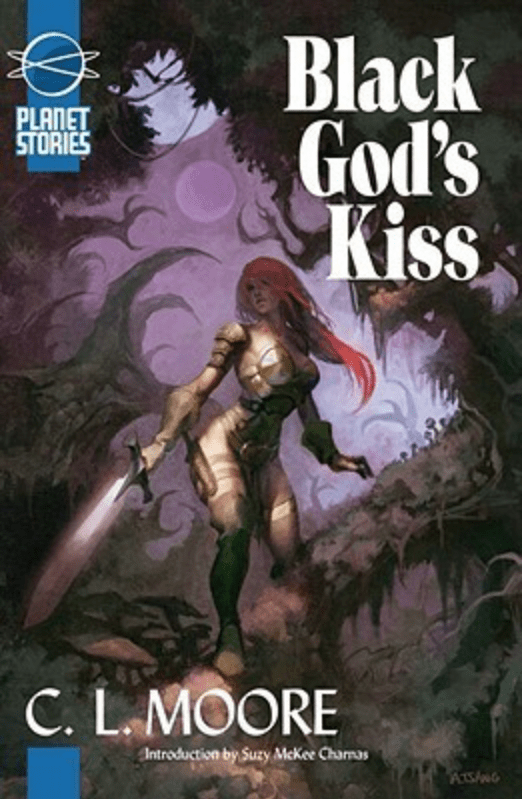
Hail! This is a continued exploration to help move the great genre of Sword and Sorcery forward to the #IronAge.
Exhibit B: The Black God’s Kiss (October 1934)
Just one year after Robert E. Howard’s The Tower of the Elephant comes an interesting offering from author C.L. Moore.
The Black God’s Kiss’ lead character is Jirel of Joiry, who many believe to be the very first female sword & sorcery protagonist.
With fiery red hair and yellow, animalistic eyes, Jirel is anything but delicate, although she’s described numerous times in her stories as feminine and desirable with a dangerous, jagged edge.
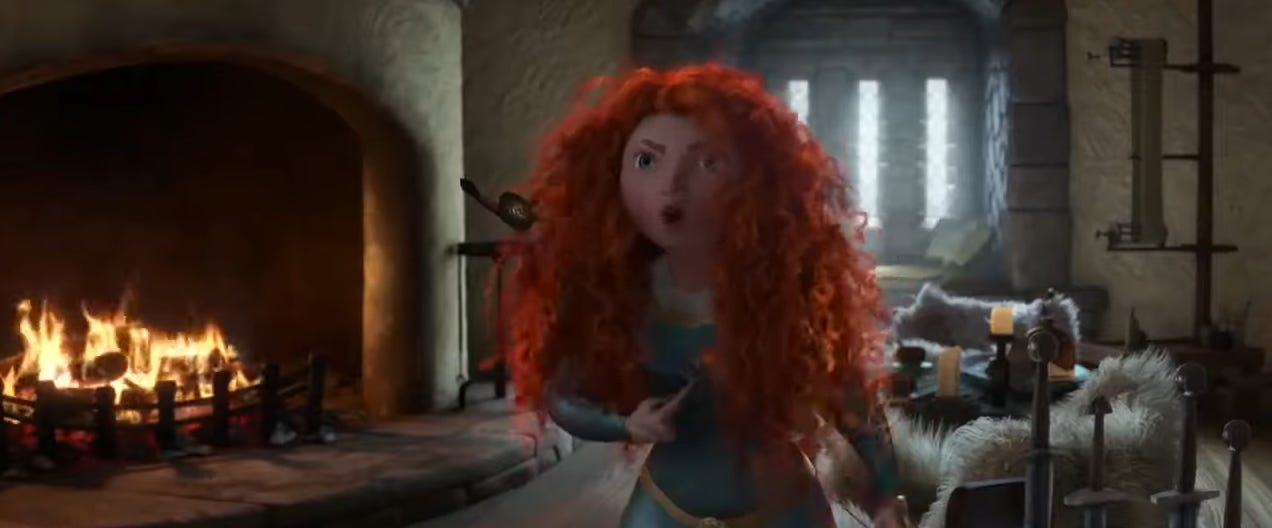
Personality-wise, I’d go as far as to say she exudes a similar energy to Xena: Warrior Princess crossed with Merida from Brave.
That’s not to say there weren’t other female S&S leads around at the time.
Robert E. Howard, who died a mere two years later in 1936, already had two red-headed female protags in his wheelhouse: Black Agnes and Red Sonya.
Uhh…That’s Sonya with a ‘y’, not a ‘j’.
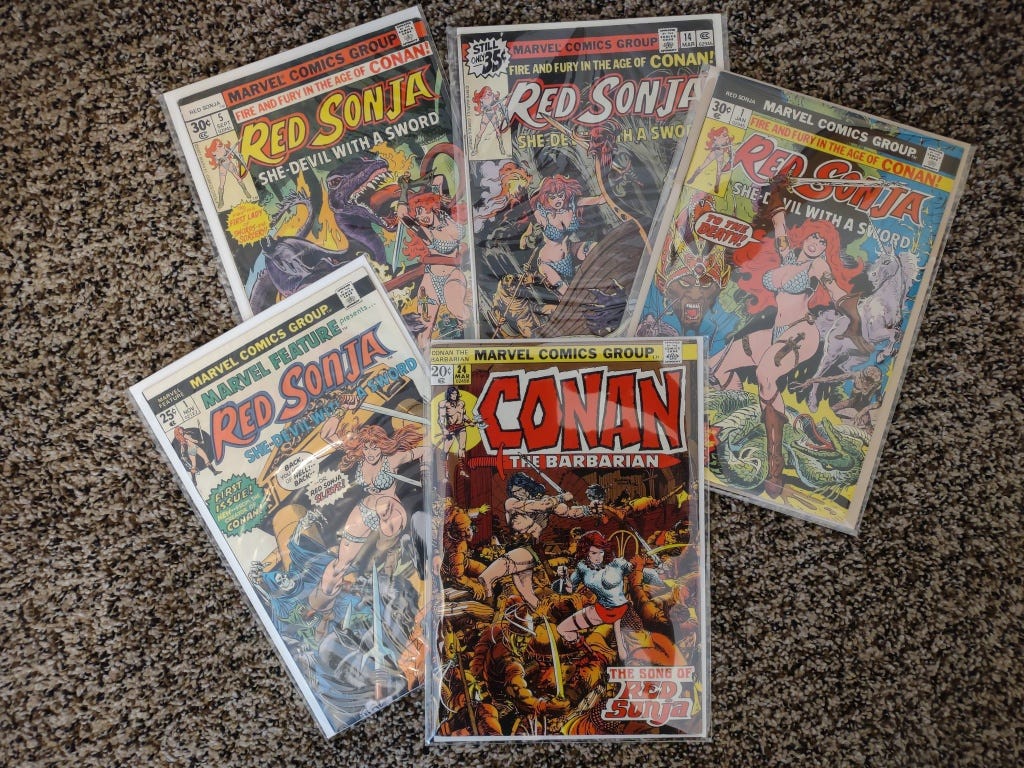
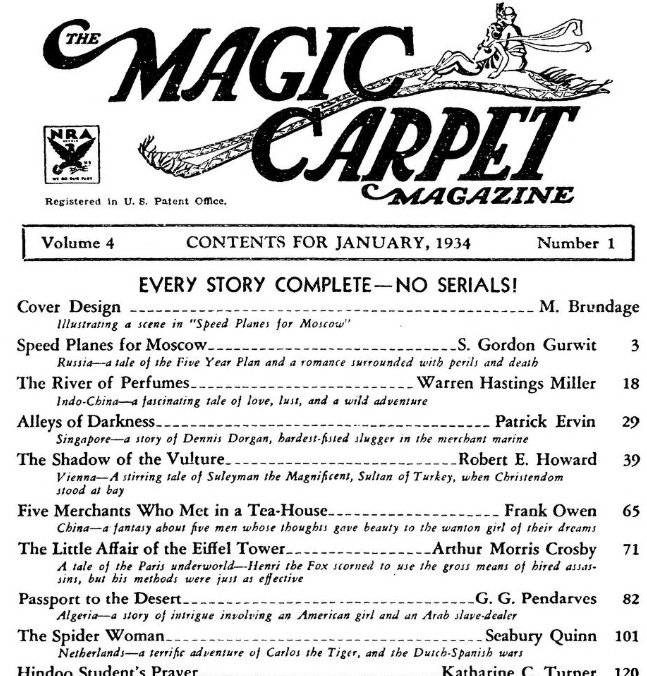
Red Sonja and Red Sonya are both quite different characters from one another, but I’ll save that for another time. Of the two, Robert E. Howard’s creation was Red Sonya of Rogatino, who first appeared in the short story Shadow of the Vulture in 1934.
The legendary Leigh Brackett once shared in an interview that Howard and Moore admired each other’s female protags, though she wasn’t certain which creator had conceived the idea of a red-headed femme warrior protag first. (Not that it really matters; The red-headed warrior goddess Scathach from Scottish mythology far predates any of this, for example.)
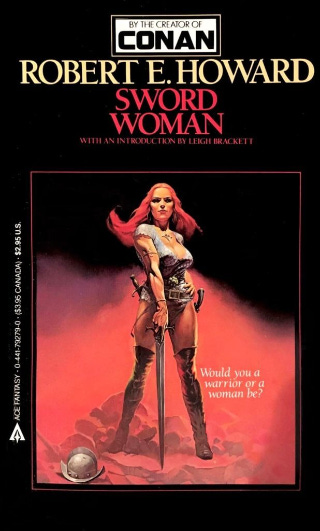
But enough about Black Agnes, Red Sonya, and Red Sonja. We’re here to talk about the awesome Jirel of Joiry, and her first outing in The Black God’s Kiss.
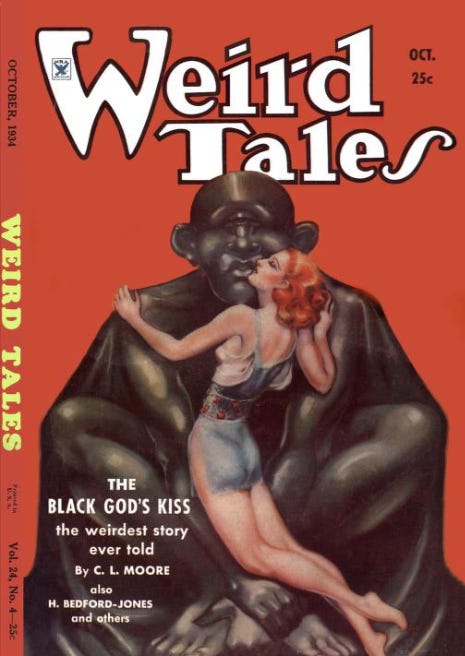
Right away, you’ll notice C.L. Moore takes a much different approach to her prose than Robert E. Howard.
As I read TBGK, it felt like the story had been typed in one go on a typewriter, her emotions spilling onto the page in a whimsical way until the story had reached its natural conclusion. If The Tower of the Elephant was a carefully planned crescendo into Weird Fiction, then The Black God’s Kiss fully embraced the Weird and ran with it through most of the tale.
It started off intriguing and grounded–and quite memorable–but quickly devolved into a stream-of-consciousness affair that dragged on far longer than needed.
However, it had enough going for it that I found the stream-of-consciousness sections enjoyable, though they could’ve used a judicious edit or two.
I’m not alone in that criticism. I’ve even heard this story described as sounding like “fan fiction”, but I feel that’s a harsh judgment. There’s a constant brilliance and style bursting off the page that’s almost impossible to replicate today.
It’s easy to forget a time when paper, ink, and typewriters were not cheap or easy to work with, so I think a lot can be forgiven if we judge it within the context of the time period. What wears our patience thin today could have made for some deep–and much needed–escapism for many midway through The Great Depression, which was absolutely in full effect at the time.
The tale starts when a larger-than-life conqueror-tyrant named Guillaume has taken over Jirel’s kingdom by force. I find the whole world has a creepy cartoon vibe to it. Like a psychedelic drug-induced nightmare:
Guillaume the conqueror leaned on his mighty sword, hand crossed on its hilt, grinning down from his height upon the furious captive before him. He was a big man, Guillaume, and he looked bigger still in his spattered armor. There was blood on his hard, scarred face, and he was grinning a white grin that split his short, curly beard glitteringly. Very splendid and very dangerous he looked, leaning on his great sword and smiling down upon fallen Joiry’s lord, struggling between the stolid men-at-arms.
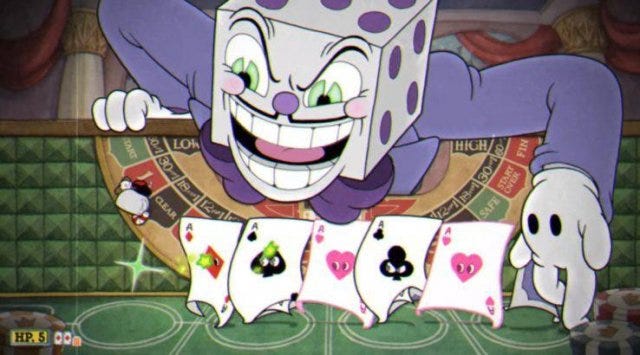
Almost sounds like Moore’s describing a boss from the video game Cuphead. (I’ve got to say, the makers of that game really nailed the style and mood of this time period. Even Guillarme’s dialogue would be right at home within the game.)
(spoilers forthcoming…)
Of course, Guillarme wants to steal a kiss from the fiery-haired vixen. Who can blame him?
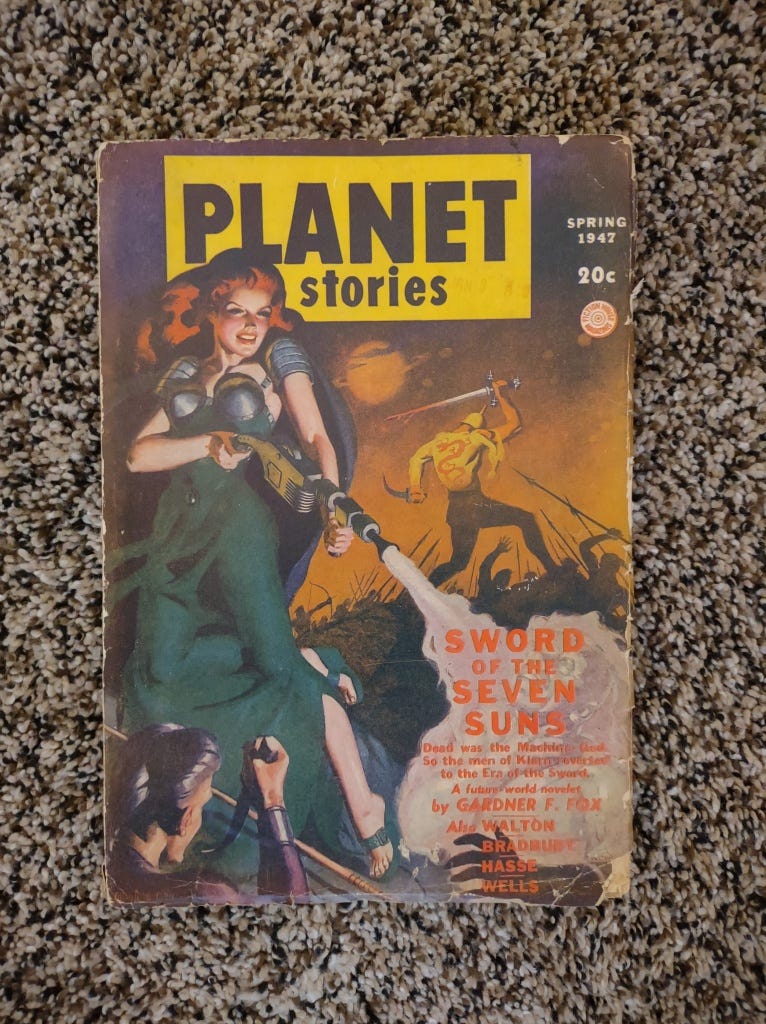
But Jirel has different plans. She makes a valiant Heavy Metal magazine-style effort to fight back in defiance against his wishes and rule.
Ultimately, she’s knocked unconscious and wakes in a dungeon cell … which she escapes from laughably fast.
After dispatching a sentinel and recovering (what’s left of) her gear–a sword, a doeskin shirt, and some chain mail–she begs her father to forgive her sins so she may go to Hell.
Yes, she wants to physically enter Hell – and wants to be free of sin before doing so. Christian fiction confirmed! She gives a dramatic teenager’s appeal on how she’d rather go down there than marry Guillarme, and won’t listen to her father’s sensible advice.
He begs her to reconsider, saying that even marrying Guillarme is preferrable to risking being imprisoned in Hell for all eternity, body and soul. …I think he had a damn good point.
But she somehow knows there’s a weapon down in the depths of Hell that will allow her to defeat Guillarme utterly, meaning this is a revenge story – even though the slip of a knife or a little poison would’ve likely gotten the job done just fine without having to kick down the gates of Hell itself.
But remember, she’s gotta do this Xena: Warrior Princess style. And going into Hell with a sword to kick butt is pretty badass.
As luck would have it, beneath her castle just happens to be an ancient, slippery ruined passageway that is, in fact, a portal to Hell, and the reason for its existence is never explained. It’s just there.
This is Sword & Sorcery, where such things don’t always need explained. And in this case it is glorious. You can have floating cities, giant monster nostrils can be mistaken for caves, portals to Hell can be hidden in the forgotten depths of your basement, and boulders can sing mystical music. The imagination is unshackled here, and purple prose needn’t bog it down.
So into Hell she goes, parkour-style, clutching a sword while donning a crucifix ’round her neck like Saint Joan of Arc.
And this is where things get ultra-Weird. And long-winded. Her descent into Hell is a drawn-out affair that takes its sweet time and feels a bit too repetitive. Since very little of this prose is grounded, you may find yourself skimming through this dreamscape to get back to the story at hand. But it definitely has its moments:
Half-way across, she saw one of the white blotches approaching her with slow, erratic movements. It bumped along unevenly, and at first she thought it might be inanimate, its approach was so indirect and purposeless. Then it blundered nearer, with that queer bumpy gait, making sucking noises in the ooze and splashing as it came.
In the starlight she saw suddenly what it was, and for an instant her heart paused and sickness rose overwhelmingly in her throat. It was a woman–a beautiful woman whose white bare body had the curves and loveliness of some marble statue. She was crouching like a frog, and as Jirel watched in stupefaction she straightened her legs abruptly and leaped as a frog leaps, only more clumsily, falling forward into the ooze a little distance beyond the watching woman. She did not seem to see Jirel. The mud-spattered face was blank. She blundered on through the mud in awkward leaps.
Jirel watched until the woman was no more than a white wandering blur in the dark, and above the shock of that sight pity was rising, and uncomprehending resentment against whatever had brought so lovely a creature into this–into blundering in frog leaps aimlessly through the mud, with empty mind and blind, staring eyes.
Haunting. I’m sure Jirel could see herself this way, as some kind of blind, aimless pawn if she were to ever become Guillarme’s wife.
Later in her journey, she comes across a twisted version of herself in a Promethean chamber and somehow knows to ask it for the weapon she seeks. She is sent on a quest to retrieve this weapon, and to avoid spoiling the ending, I’ll leave it at that. But rest assured her journey does lead her to the “Black God” mentioned in the title.
Certainly an interesting tale for two main reasons: (1.) It proved to audiences that S&S can easily pull off a believable female protagonist, and (2.) it proved that the Weird dial can be safely cranked to 11.
How The Black God’s Kiss can help inform our S&S efforts today:
Despite the story needing a bit more help from the Pyramid of Abstraction, people still talk about Jirel of Joiry to this day, just as they do Black Agnes, Red Sonya, Fafhrd and the Gray Mouser, and Elric of Melniboné.
What do all these characters have in common? They’re all unique in that they stand out compared to your typical Sword & Sorcery protag.
We can conclude that main characters should have some kind of recognizable x-factor that set them apart. Being female or being a pair of thieves may not be enough to stand out these days, so I’d really want to find some Strange Attractors when developing a good S&S protagonist, something that people won’t easily forget.
Michael Moorcock definitely pulled this off with Elric to great effect.
And if The Tower of the Elephant weren’t proof enough, I believe easy access to Weird Fiction is one of S&S‘s biggest strengths, hands-down. It lets writers stretch their imagination farther than most genres allow, and can be a memorable way to make dungeons and monster encounters that much more haunting. It allows us to sear our own signature brands of madness into these worlds, leaving a uniqueness not easily forgotten.
More forthcoming.
 Nick Enlowe
9 thoughts on “The Riddle of Iron Part 3: Jirel of Joiry”