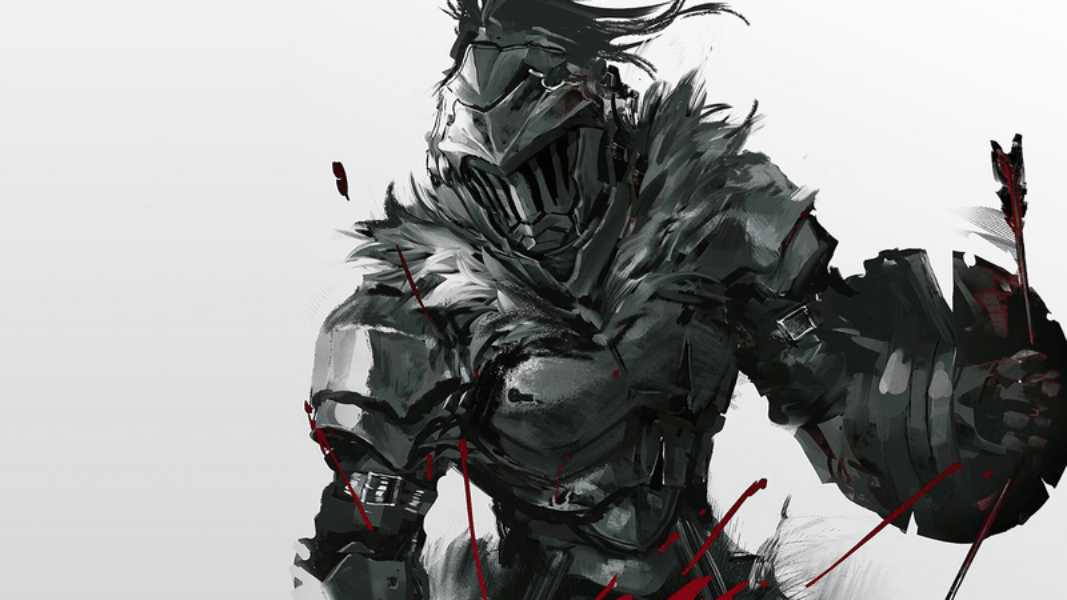
I believe we’re closing in on the answer to the Riddle of Iron. Let’s see what else we can figure out for the glory of the #IronAge!
Part 1. (What is Sword & Sorcery?)
Sword and Sorcery in Unexpected Places #2: Goblin Slayer
I’m going to talk about the first season of the anime here. Not the movie or the manga. I’ll tag any spoilers ahead of time.
People view Goblin Slayer as a deconstruction of fantasy tropes, but it’s actually a different take on Sword & Sorcery. In fact, I’d consider it more of a reconstruction. It’s one of those titles that seems like it may be subversive at first. But, given half-a-chance, it quickly proves itself as superversive. Even heroic.
Most likely, you’ll carry several expectations into a first viewing of Goblin Slayer:
First and foremost, when most people think of goblins, they think of low-level “yard trash”, or fetchquest-tier monsters. Gobbos are typically more of an inconvenience while traveling in the Tabletop RPG-ers mind, the video-gamer’s mind, and even the reader’s mind. Goblins generally aren’t worth an adventurer’s time past those early levels.

Second, you should be asking yourself how an entire season’s-worth of interesting content can be derived around the simple concept of a man slaying goblins.
Kumo Kagyu knew the above two expectations potential fans would have when creating the story and used them to his advantage. (I won’t get into its ASCII messageboard and light novel origins, here.)
Third, you should know (and have probably heard by now), that this anime is absolutely not for children. However, what it does is not done for shock value so much as for “Wood Perilous” purposes.
But that’s not to say there’s no shock value to the intro – Goblin Slayer hits the viewer like a freight train with a series of opening scenes–an extended prologue of sorts–that sets new expectations for the viewer. It lets you know upfront that this show is playing with an entirely different set of cards than you’re used to, showing you a scenario that is as haunting as it is unforgettable.
Goblin Slayer Episode 1 spoilers start here:
GS starts with a flash-forward to an innocent-looking priestess covered in blood, shivering and horrified. The titular Goblin Slayer approaches, a ghostly red light shining in one of his eyes.
We hear a voiceover, a cheerful younger version of the healer say she someday wants to be an adventurer.
There’s a pan over a cliché mediaeval Europe-esque setting. The same priestess we saw earlier is being interviewed and filling out an application. A cute, friendly guild mistress is working the front desk of the adventurer’s guild with a disarming smile.
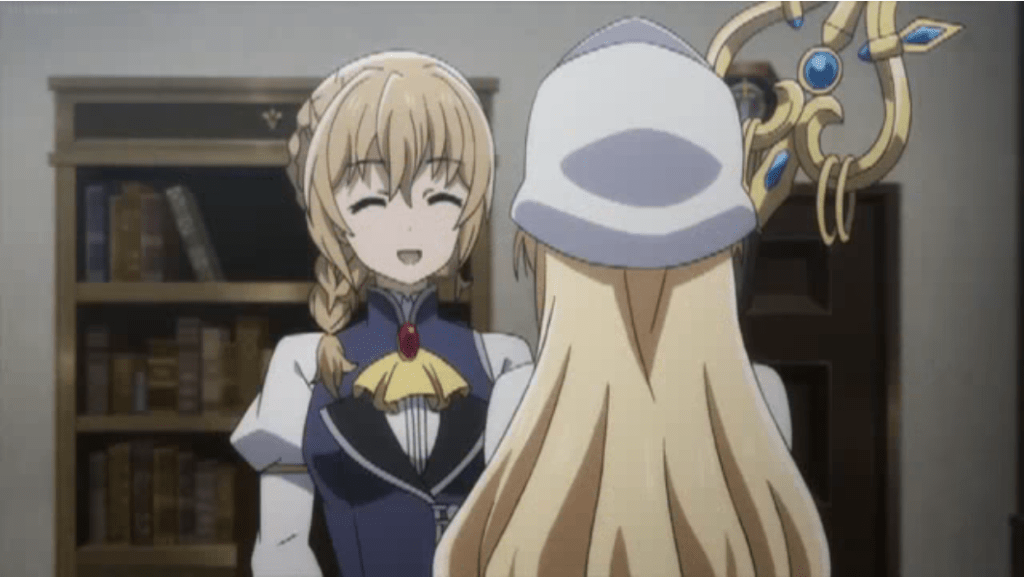
Japanese RPGs often have this aesthetic, this cheerful visage for adventure guilds, happy cute girls handing out fun adventures without a care in the world. The background music is happy and upbeat, but that brief intro sticks in your mind leaving an uneasy, unsettling feeling. It’s like this whole place is a setup just to mislead the poor girl, like an army recruiter sweet-talking teens into heading to Vietnam just to meet a quota.
The priestess’ lifelong desire has been to help other adventurers and she’s been training in a temple her whole life to make that dream come true. Which insinuates heavily that there’s some propaganda in this world, an effort to romanticize adventuring to the youth.
The priestess overhears the chatter around the guild, seasoned adventurers bragging and posturing about the types of creatures they’ve slain, and speculation on whether or not they can handle even stronger monsters like Manticores and Demon Lords.
She’s handed a porcelain identification tag, and it’s designed to look conspicuously like a soldier’s dogtags. There’s handwavium performed by the guild mistress as she talks about the ten adventurer ranks and how the priestess is now “Porcelain”, the first rank. It’s only at the end of the conversation that she tacks on that these ID tags might be a way to identify her body, should something go wrong.
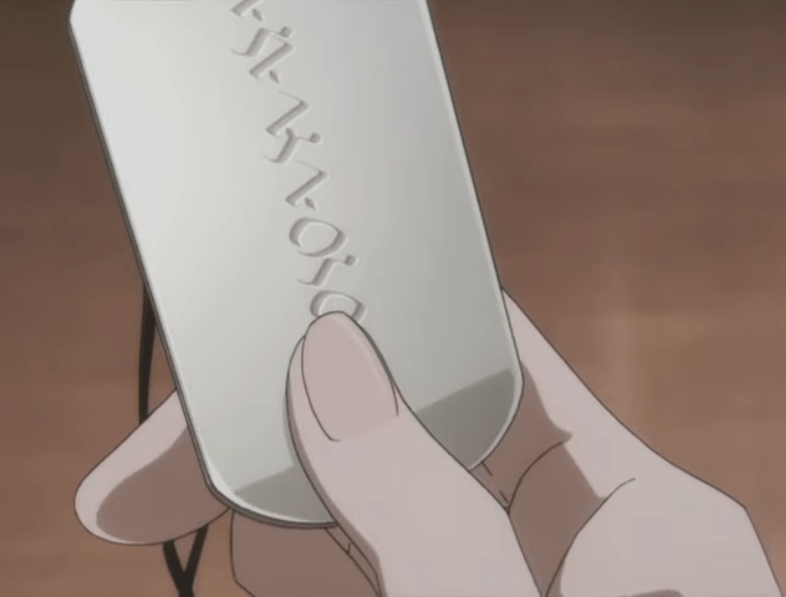
The priestess acts like receiving her ID tag is one of the best things that’s ever happened to her, but, boy, it sure makes for some dark foreshadowing.
A friendly group of adventurers show up, all smiles, all confidence. They’re fairly low level, but they’ve seen some early success. Turns out they’re looking for a healer so they can get on with an “urgent” quest. Seems some gobbos attacked a village and stole supplies and livestock. Which indicates goblins have needs and fulfill them, interacting within the greater economic system of the Goblin Slayer world. Goblins are economy disrupters and their raids are felt in impactful ways, which add more realism to the threat. Oh, and the group leader tacks on “they even kidnapped some girls”, which is why he feels this quest is urgent.
The secretary shows concern, saying all three of these adventurers are porcelain rank. She strongly advises they wait for at least one higher rank adventurer before they depart. But their leader is anxious to get going and save these kidnapped girls, and he’s confident that the four of them could easily handle a few goblins. The rest of the group agrees emphatically so the priestess decides to go with, despite the many red flags.
Deep in a lush forest, they find the goblin lair, a cave secluded in a rocky valley. A crude pagan skull effigy at the entrance gives the priestess pause. She takes a deep breath before daring to enter the dark cave, as there’s this distinct feeling they’re invading a space where they don’t belong.
When she voices her concerns, the guild leader laughs and calls her a “worrywart”, stating goblins are like children. They’re the weakest monsters you could possibly run into. She warns them that she can only cast three heal spells after learning they don’t even have potions. But the group’s confidence is through the roof, believing this mission will be easy and that one day they’ll work their way up to slaying a dragon.
When they finally encounter the goblins, things go well, at first.
But you get this sick feeling in your stomach the moment things start going horribly wrong. It’s all the slight miscalculations that add up: The mage who can’t see without her glasses, the ceiling not providing quite enough clearance to swing a longsword overhead, poor communication, and a failure to stick together.
They went in pompous, full of pride, only to be blindsided by reality. This is what happens to people who are gaslit to believe that threats are not threats. This phenomenon is what happens when we fail to teach our children of the Wood Perilous.
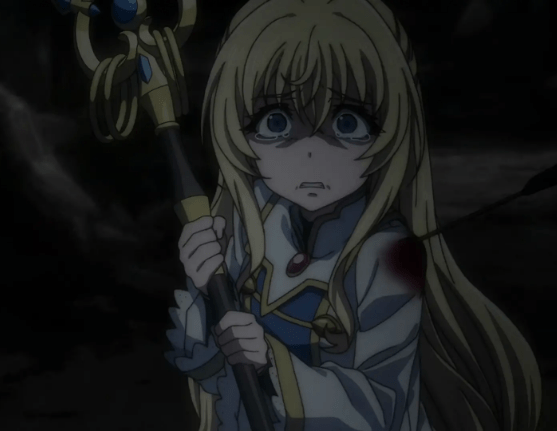
By the end, you see that same disturbed look on the priestess’ face. It’s like the world had forgotten these creatures were depraved monsters, capable of the most unthinkable acts. They’re Evil with a capital “e”.
The realism of an arrow in your shoulder, or a dagger shoved into your chest, or monster claws sinking into your back, or the horror of things unspeakably worse don’t fully dawn on you until it’s physically happening. Only then do you wake up. This is what happens to those who are not aware of the Wood Perilous. They only wake up when it’s too late.
All manner of cruelty that goes below the depths of humanity are happening in this dark cave around the priestess, obscured just enough by darkness that sounds and the art of suggestion fill in the rest. The cruelties found here stand in stark contrast with the friendly façade and smooth veneer of the adventurer’s guild to great effect.
This is a story about the realities of war. A realistic approach to what a world filled with monsters would really be like.
It’s important to note that, contrary to what you may hear, at no point does the show fetishize any of this. Instead, it shows the dangers of Evil which sets the stakes sky high and makes every decision difficult and every situation unnerving.
What follows is the true introduction of the main character, heroism and expertise on full display, and a surprisingly emotional journey of hard-learned lessons for the priestess. This show–even this episode–gets poignant like few anime I’ve ever seen. The priestess is emotionally rocked like a character bewildered in the fog of war Saving Private Ryan-style, her character growth the likes of which you’ll rarely see in a single episode of anything.
But this introduction also sets up several expectations for the end of the show. It’s similar, in that respect, to the prologue for A Song of Ice and Fire. You know there’s going to be a situation presented where even the Goblin Slayer himself will get in over his head.
The Perils of the Dungeon Crawl
This show captures the dungeon crawl experience perfectly. Being prepared is sometimes not enough – And this is the kind of show where characters bring canaries to test for breathable air.
Even if you’re taking your time, carefully disarming traps, knowing what to look for, a dungeon can still throw you into an unexpected and dire situation within seconds, forcing you into desperate improvisation.
The magic system is also limited. Characters can cast magic three times a day. That’s it. If you’re a healer and you’ve cast three spells, all you’ve got left is your remaining comrades and your ineffective staff to hold the monsters at bay. The characters in this world have to come with MacGuyver-like supplies as a backup plan if they want to survive.
Goblin Slayer late season 1 spoilers start here:
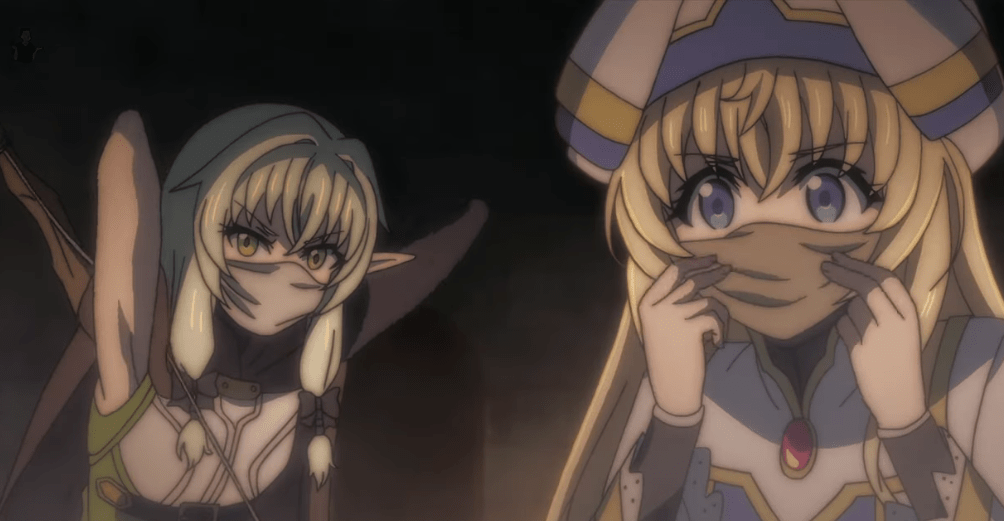
In a scenario late in season 1, the group is fooled by a trap; a skeleton disguised as a prisoner served as the decoy. The door behind them seals shut and poison gas starts filling the room.
Goblin Slayer, thinking on his toes, coats several pieces of fabric in charcoal and has the party members breathe through them. Then they use a mixture of lime and volcanic soil to seal off the gas leak, preparing for the inescapable ambush that’s likely to follow.
These are the kinds of tight scenarios the characters are regularly faced with, and it keeps you on the edge of your seat because the whole time, you know the grim and dire stakes should they ever lose.
Conclusions
Dungeons are cool, but they can also be horrifying. Have your characters go into situations thinking they’re prepared, only to find out they’re not. Raise those stakes. Put them in a desperate situation where their various areas of expertise and ability to work as a team can shine.
If your story can handle it, monsters should be just that: monstrous. If your story is realistic, do not shy away from Evil, pretending like it doesn’t exist. Shying away from the darkness of the world creates a gaslight effect, making people believe the world is safer than it actually is.
Again, not every story needs to portray Evil, but the stories that should often actively avoid it for fear of offending someone in an unhealthy society, and that is where the danger lies.
You hear about it all the time: A Japanese teen climbs Mt. Fuji without proper gear, an amateur father and son diving team attempt a spelunking expedition in Eagle’s Nest, a naïve female activist hitchhikes through Turkey to “promote world peace”, only for things to turn unimaginably ugly.
Dispelling the Notion of Multiculturalism
Everyone’s an individual. You give five people the exact same plot and tell them each to write a story, you’re going to end up with five wildly different takes. This is true whether it’s done in the United States or Germany or Japan.
You might think Goblin Slayer is innovative because of “diversity”. Because it came from Japanese minds and was integrated with Japanese culture. And, to a certain extent, that’s true. If Japan fully embraced diversity, however, they’d become a grey goo of “all-culture”, like the US and Europe are quickly becoming. Since they’re still hot enough to be a melting pot, their culture remains delightfully unique from the rest of the world.
But the genius of Goblin Slayer goes far beyond that. Even among the Japanese, Kumo Kagyu’s take on this genre was deeply controversial. It was also a sight to behold – Innovative storytelling at a level rarely seen.
Quick Final Thoughts
I have thoughts on the title character as well, but that will have to wait for the next post.
Season 2 of Goblin Slayer quickly approaches; the trailer recently dropped. If you want to experience Goblin Slayer, I highly recommend you check out the first episode of the anime in Japanese with English subtitles. The English dub goes a little too overboard with the screaming, but the Japanese voice actors get it just right. The anime is also far less graphic than the manga, so if you value custody of the eyes, the anime is the way to go.
If you can stomach the first episode, I’m happy to say the rest of the season is much easier to handle. And then you get to watch the movie, which is one of the best anime movies I’ve ever seen.
Once again, don’t show Goblin Slayer to your children, and I would honestly hesitate showing this to teens. Anyone who can’t handle Game of Thrones probably shouldn’t view this show. But for those of us who can appreciate the innovative storytelling this IP has to offer, here’s hoping season 2 can continue carrying the torch.
 Nick Enlowe
One thought on “The Riddle of Iron Part 10: Sword and Sorcery in Unexpected Places #2: Goblin Slayer”