
I’m sure you’re all familiar with the classic thought experiment.
But to refresh your memory, this quantum mechanics thought exercise is a hypothetical scientific paradox in which a living cat is placed in a metal box with a sealed flask of hydrocyanic acid. There is a hammer inside rigged to either smash, or not smash, the flask every second.
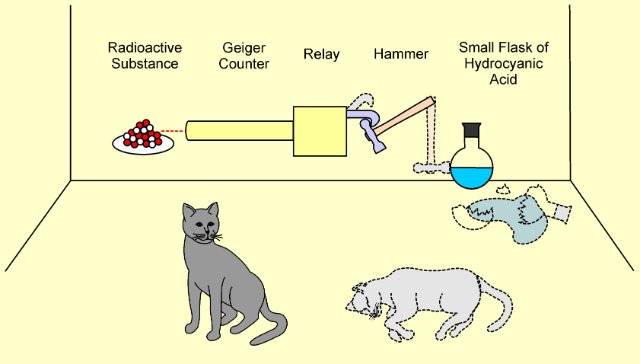
Furthermore, there is a small view pane which requires the scientists to approach the box in order to observe the cat’s state of life (or unlife) so they may record it.
Schrödinger created this thought experiment to point out the absurdity of the “Copenhagen interpretation”, which states that something indeterminant is considered as “both states” until measuring it proves otherwise.
In other words, Schrödinger was saying a science experiment shouldn’t be able to record that the cat is both alive and dead simultaneously before scientists are able to observe the subject. Rather, they should acknowledge that it’s either alive or dead even before observation.
Of course, life and death are very much binary states, so presupposing something as both alive and dead is absurd. But so is the idea that the cat’s state requires observation to be alive or dead in the first place.
That’s the paradox, the problem that has not yet been solved: Science defines the moment the cat dies as a collapse of “quantum superposition”. And what troubles quantum mathematicians most is that they cannot measure when–or if–a quantum superposition will collapse (ie: whether or not the cat will die from a chemical reaction, and precisely how long before it will happen.)
I’m sure scientists would love to know exactly when they’re going to die and how to prevent it, which goes back to what I’ve said regarding the Philosopher’s Stone.
Thing is, God knows. He knows the exact millisecond the cat dies without needing to observe and record it, He knows who is at fault, and He knows the mathematics behind what has happened, which is infinitely complex. He does not need to define a death as a collapse of quantum superposition because he is omnipresent, in His mind there’s no such thing as a sudden and unexpected “collapse”, and the mathematics of what goes on under-the-hood are wholly of his design, far beyond the grasp of humans (or even human invention). If there was a collapse of anything that caused the cat’s death, it was a collapse of human moral judgment.
In short, a scientist’s ability to record a cat’s status doesn’t suddenly and magically change its state to alive or dead. (There are obvious and disturbing comparisons to when a baby is suddenly considered scientifically “alive” when comparing Schrödinger’s box to a womb.)
Being able to predict these quantum collapses is forever beyond the grasp of humans. That’s what troubles scientists the most; the idea that the cat’s state requires observation to be alive or dead supports a Science Positivism worldview, a movement which went to great lengths to state that anything which cannot be scientifically measured should be thrown out and considered meaningless (including religion).
And that’s exactly what’s wrong with Schrödinger’s Cat. It presupposes a purely scientific worldview. Leaves no room for wonder. It reimagines life as a game of numbers, a worldview where the miracle of life is degraded into a statistic and death is a “quantum accident”. And thus, we’ve been robbed of our imagination.
That wonder, my friends, is what we should be striving to recapture while writing fiction. The goal is to remind everyone of the beauty that surrounds us, and the miracle of being alive. Beauty and life cannot be boiled down to mere numbers. They go far beyond math and into the spiritual realm, well out of reach of scientists.
It turns out that, when the dust clears, all it takes is a simple cat to prove them wrong.
 Nick Enlowe