Series starts here.
By this point, I’d been playing Metroid off-and-on for the better part of a year.
In the meanwhile, I got to experience many other games at friends houses such as Trojan, Gradius, Pro Wrestling, Tiger-Heli, The Legend of Zelda, and Castlevania. Nintendo subculture was taking on a life of its own, already poised to become something truly special to the children of Gen Y, and to a lesser extent, Gen X.
But nobody else in my circle seemed to have Metroid, so I was still on my own.
That was okay. I had a notebook filled with passwords I’d scrawled down with No.2 pencils, hand-drawn maps, and I was figuring out many tricks that most scrubs doing Let’s Plays can’t figure out to this day (and they often unfairly criticize the game due to their lack of game mechanic knowledge).
For example, if you roll off of a ledge and stand up in midair, you can jump off of nothing as if you were standing on an invisible platform. Sort of like Diddy Kong’s roll in Donkey Kong Country. This technique allows you to tackle several otherwise tricky jumps in the game far more easily.

Then, of course, there’s bomb chaining. If you time your bombs just right, you can launch yourself in the air higher and higher. There’s a particular point in the game where this is required, proving the developers included this mechanic on purpose, hoping it would be something you would master:

Most casual Metroid players will spend several minutes here spamming the bomb button or holding turbo, hoping the magic eventually happens. And it will.
But if one learns the cadence and get it just right (~134 beats-per-minute), you can tackle challenges like that vertical shaft on your first try, and even use it to brute force your way out of otherwise punishing pits, no matter how deep they are, such as this one below:

You can even combine the above two tricks by bombing, standing at the height of the blast, and then jumping in mid-air.
But the most egregious mistake, the thing that really confounds most modern Metroid players–and even veterans–into giving the original Metroid a bad review are these infamous portholes, which are all over the place in the game.
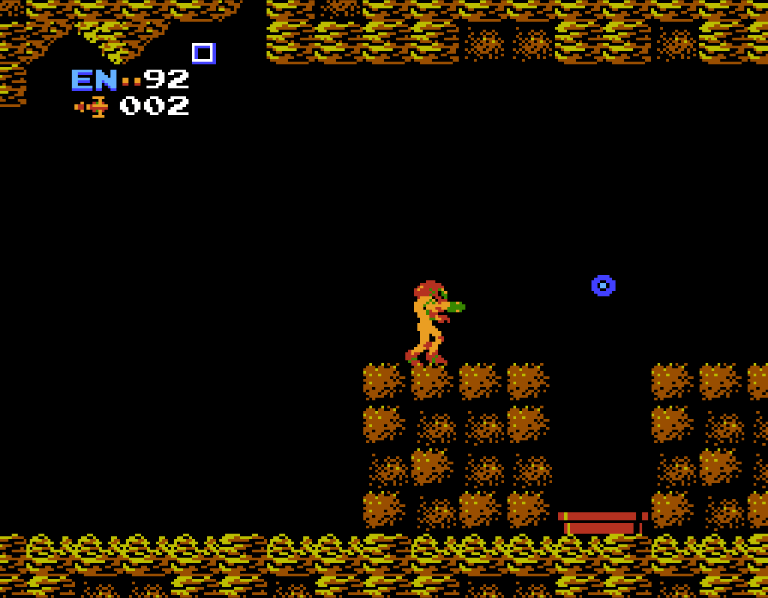
And boy, do they get mad.

Here’s the infamous Angry Video Game Nerd making the same mistake, spending hours getting frustrated at a spawn porthole for no good reason:
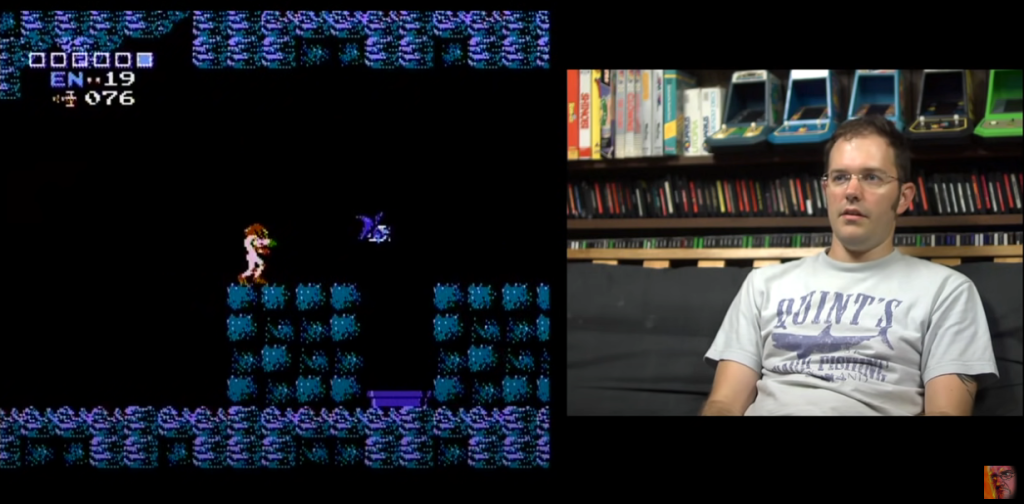
What he’s trying to do is refill all his missiles and Energy by using his freeze ray on enemies one at a time, hoping to refill 200-some missiles and 600 Energy to prepare for the final area. Of course, using the freeze ray means that killing enemies takes twice as long as normal (because only every other shot does damage when it unfreezes enemies). He even goes as far as to fast-forward all the footage of him doing this.
These players correctly identify that the portholes were placed in the game as easier ways to refill your health and missiles. But if you die, you go down to 30 health and 10 missiles. Refilling your supplies takes a Herculean effort using the method the AVGN is attempting above. And he’s not alone: Almost no one seems to know the trick I’m about to talk about.
Before I move on, there’s an alternative to using portholes to refilling your Energy: If you find an “Energy Tank”, it refills your health to full. There are plenty of extra Energy Tanks in the game for this purpose, and sometimes it’s strategic and wise to leave one or two behind for a convenient Energy refill.
But finding a Missile upgrade does not refill all your missiles, so that brings us back to the porthole method.
The mechanics of portholes work like this: They will infinitely spawn monsters that fly toward you at your current height, one at a time. Once a porthole-spawned enemy is defeated, another will immediately spawn.
But if you freeze the enemy, no more enemies spawn from that porthole since it can only spawn one enemy at a time.
If you defeat an enemy and it drops a power-up, the existence of the power-up also halts the porthole from spawning more enemies. But the moment you grab the power-up (or the moment it times out and fades away), another enemy will immediately spawn.
Finally–and this is key–if you are standing directly on the porthole, no enemies will spawn.
What you, the player, were supposed to figure out is that if you bomb the porthole directly, it will kill the next enemy and give you powerups, allowing you to quickly and painlessly refill your missiles and Energy without jumping around for hours, freezing and unfreezing enemies like you’re in some kind of clown show.
I’m astounded at how few people know this simple trick. To even get these screenshots, I had to pop in the game myself.


Since most people were too dense to figure this out, Nintendo ended up having to include “charging stations” in the sequels.
Here are Energy and Missile refill blocks as seen in Metroid II: Return of Samus:

And here’s a refill station in Super Metroid:

In later sequels, they end up combining Energy, Missile, and Save spots to dumb the series down even further.
What’s kind of ridiculous is that players don’t seem to understand even the most simple tricks that you can perform in Metroid, but they’re performing absurd shinespark, megabomb, and walljump shenanigans and skips all over the place in Super Metroid.
I guess most people are in such a hurry to play through their backlogs, they don’t bother to spend much time with the original Metroid and give it the attention it deserves.
 Nick Enlowe
One thought on “The Metroid Reveal was a Dirty Setup (part 5)”