Series starts here.
After ascending the final elevator, you get your clear screen and a congratulatory message.

And then you get an ending that is based on your completion time (but the game doesn’t tell you that). Since I’d been playing for months, it’s pretty obvious I got the 10+ hour ending:

This is the ending that most kids would’ve gotten on their first (and perhaps only) playthrough. Remember, most of us didn’t have maps to work off of, or strategy guides, or anything. The internet was still government-access only, soon to be opened up to only the most extreme of geeks. All us kids could go off of was playground rumors and our own individual experiences.
Anyway, victory music never sounded so sweet. NES games with actual endings and a credit roll were rare back in 1986 (and only started getting slightly more common in ’87). I’d never beaten a game with robust ending credits like this, so it was an extra-special treat for me, making the whole experience feel like I’d just watched an epic movie.

And that was it. I still had no reason to believe Samus was a woman because I’d been told she was a man multiple times. The game and ending gave me nothing to start thinking otherwise, other than the loose references I’d noticed to the Alien movie franchise.
I told my friends at grade school I’d beaten Metroid, and nobody really cared too much because they didn’t have the game (Metroid wasn’t all that popular, I guess). Luckily, I happened to live next door to a high school, and in the morning I’d sometimes sit on the fence outside of my house to say hi to the teenage students I knew, such as my various babysitters.
There were a few Gen X students I happened to know were into NES and likely owned Metroid. They thought it was really cool someone as young as me managed to clear the game. But even they never gave any indication that Samus might have been a woman.
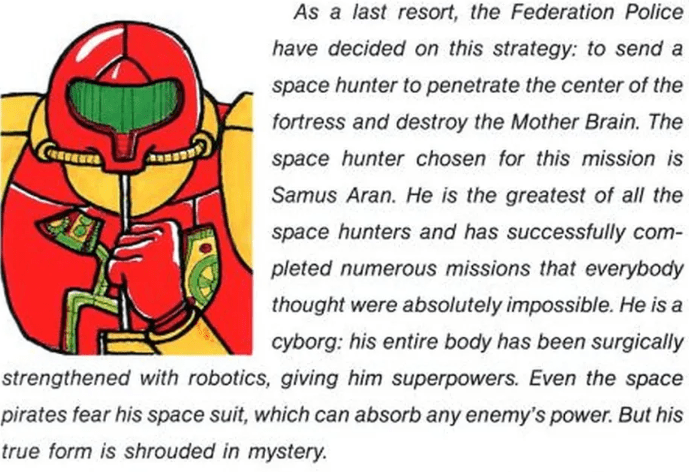
And why would they? The commercials depicted Samus as a male. The instruction booklet refers to Samus as “he” multiple times. The main strategy guide that was out at the time included a manga comic that also referred to Samus as male:
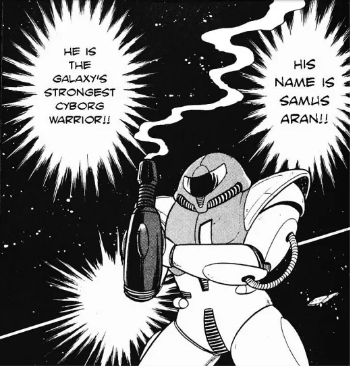
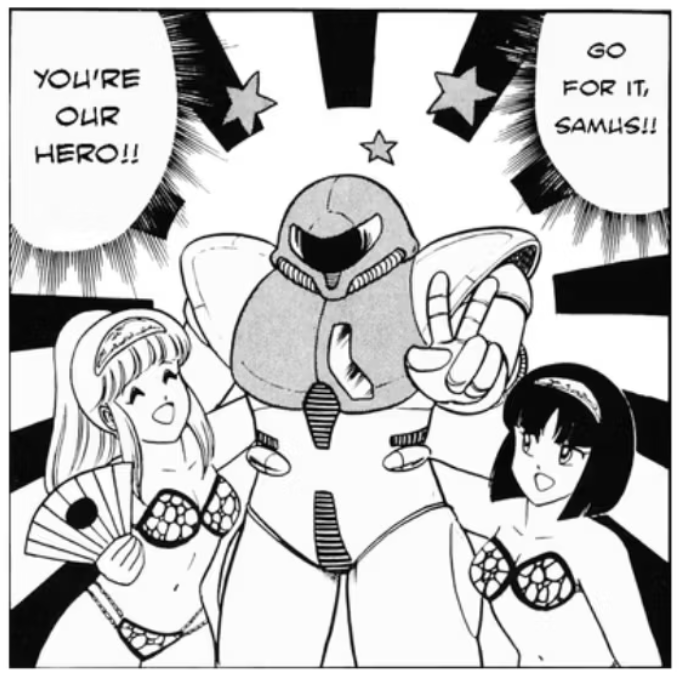
Over and over again, we see Samus referred to specifically as a male cyborg.
Admit it, if you were raised around this stuff in the mid-80s, you’d have assumed the very same thing. And it wouldn’t have been “because you were sexist”. The only way to assume Samus’ gender was anything but what was advertised would be to assume Nintendo was deliberately lying to you, a radical leap in logic.
But as it turned out, they were. Maybe Big N was afraid a female lead would hurt sales. Whatever the case, the Silent Generation and Baby Boomers were running things up top. Just like with what was printed in our history and science books, us kids had no say in the matter. And we’d soon prove them wrong by buying and loving many games with female leads in the second half of the decade.
Even in that strategy guide comic strip, the writers dropped a subtle hint that they knew Samus is actually a woman, but weren’t allowed to tell us:

There was even a proposed animated TV series, and the concept artists either had no idea Samus was a woman, or was told to make Samus a man anyway to keep up the masquerade.

Some of the confusion could be chalked up to the fact that Japanese pronouns are genderless, so there was the very real chance that translators would translate to masculine pronouns (which was default back then — if ‘he’ was said and the gender was unknown, it was to be interpreted as ‘he or she’, to be determined in context. But we didn’t have to write ‘he or she’ out every time because it was deemed too cantankerous, and we correctly knew that caving to the idea of writing ‘he or she’ every time was a slippery slope that could lead us to … well, look at the incredibly ridiculous alphabet soup we now have on our hands.)
But I believe there’s sufficient evidence that Nintendo at least had some of these magazine journalists sign an NDA regarding the ending of the game and the secret to Samus’ “true self”, to the point where they had no choice but to lie to children, just like how the official instruction manual did.
It wasn’t until October 1991–five years after the game’s release–that the now famous “Justin Bailey” code was published in Nintendo Power. This was most kid’s first experience seeing that Samus was a girl. But by then, we were more than plenty used to female main characters in video games. There was a huge surge of them in the late 80s and early 90s, and many of those games are considered classics, are valuable, and are greatly desired by collectors today.
It wasn’t some kind of cathartic experience for 80s kids viewing Metroid’s ending screen like some revisionists like to retcon it to be–it was… mostly seeing that you’re now playing as a green-haired chick from inputting this very code and going, “huh,” if even that.

Nintendo Power asks an appropriate question here: “Justin who?” Even they didn’t know what the heck was going on anymore. And note the issue doesn’t mention anywhere that if you enter that code, it reveals Samus is a female. It just makes passing mention of the missiles and energy tanks, like the sudden gender-flip is no big deal. Or, it’s almost like most people already kinda knew and took it for granted.
And, to be frank, it wasn’t a big deal. We didn’t put much stock in gender and identity back in the 80’s. We just wanted to have fun playing video games. But still, we were curious to know the answer to the very question Nintendo posed: Who is Justin Bailey?
Mysteries are intriguing, after all.
Though the code was just a corner mention at the end of a multi-page spread to hype the release of Metroid II: Return of Samus, that little box and the code within it lived on in infamy, and fans wrote in about it in droves. Gamers were dying to know who–or what–Justin Bailey is. Could it be the name of the character you play as when you enter that code? Could it be some translator who thought it would be amusing to include his name as a secret code?
The first mention of this code actually predated the mention in Nintendo Power, published in Boys’ Life magazine. And even then, the writers were under the impression the code somehow changed Samus into a female. Again, this is understandable since every reference outside of the game referred to Samus as a “he”.
Nintendo Power eventually had to speculate on the answer to appease fans. They offered that the code meant “just in bailey”, as in, just wearing a swimsuit. But that was a tough pill to swallow even back then. The use of “bailey” as a slang term for swimsuit was already archaic at best, and fell out of general use after “roaring” 1920s.
Sure enough, the explanation ended up being B.S., too.
To this day, no one knows who discovered this code. What we do know is the Nintendo developers used a code randomizer to create all the passcodes for the game, and there are a few passcodes that happen to be human-understandable by pure coincidence.
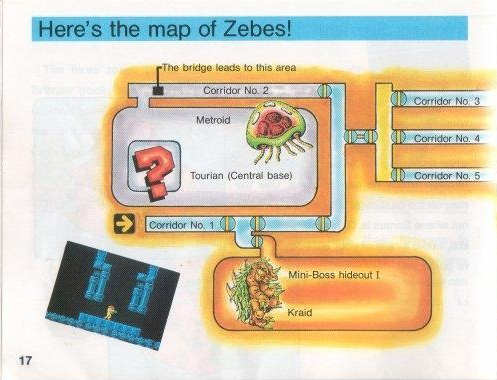
Case-in-point, aside from “JUSTIN BAILEY”, there’s also “ENGAGE RIDLEY MOTHER-FERS”, a code that family-friendly Nintendo would’ve never put into place knowingly. But really, it’s no mystery as to how kids discovered these codes. We didn’t have much better to do than spend hours, or even days, guessing codes on screens like this.
The guy who submitted the code to Boys’ Life was tracked down. His name was not Justin Bailey, he doesn’t recall who told him the code, and the only person in his town named Justin Bailey was two years old at the time the code was submitted. And that Justin Bailey never answers his phone when journalists try to call him, so the mystery lives on.
Personally, I’d known Samus was female for years by the time the Justin Bailey code had surfaced and gained popularity. After I’d beaten the game the first time, I decided to give it another go from the beginning. Naturally, it’s far easier the second time.
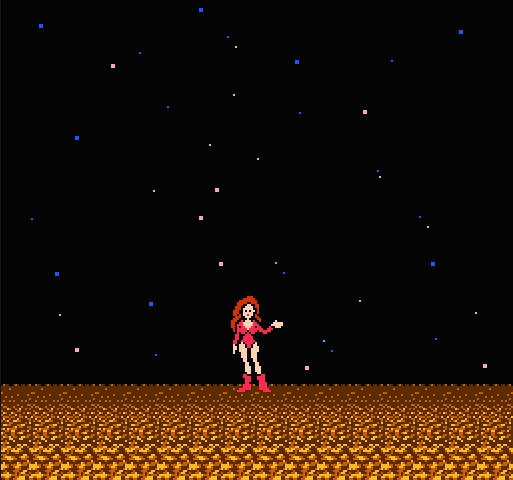
Seeing this screen in late 1987 made me realize gender was a construct. That everything I’d ever learned was a lie. I ran right out and bought the first pink t-shirt I could find and declared war against the Patriarchy.
Or not. Like I said, I was half-expecting it. I basically figured she was an homage to Lt. Ellen Ripley from Aliens. Turned out I was basically right (the development team has said as much in interviews). It was literally no big deal to me or most of my friends to find out Samus was a girl.
I didn’t even feel the need to tell others about THE BIG REVEAL at the end, because it didn’t matter much to me. I think Nintendo thought this would be far more shocking that it actually was to the U.S. audience. Ehhh, it was kind of a dud.
The impact this game left on the gaming world was more related to its exploratory gameplay, creative power-ups, and contribution to the NES’s legacy more than anything else.
Did you know you play as a female blowfish in Clu Clu Land? Does it matter? How about that you play as a female in Ms. Pac-Man? Pooyan? Valis? Layla? Kangaroo? Wing of Madoola? Yar’s Revenge? Valkyrie? Ice Climber? Lady Bug? Kiki KaiKai? Athena? These are all games released prior to or near the release of Metroid, and none of those titles felt the need to deceive the player.
If you ask “video game historians” who specialize in “female representation in video games”, most will first of all incorrectly credit Metroid as the first game with a “proper female lead”, and secondly say that the ending to Metroid is one of the top ten best endings of all time specifically due to the “gender reveal”. Thirdly, they’ll likely say the “trend” of female leads in video games started around the mid-80s.
None of those statements are true, even considering that most main character depictions prior to 1985 were genderless, such as a spaceship, or a bucket, or a mouse, or a … square… or… rectangle. The graphics just weren’t there yet, folks. And a lot of the examples I gave above were from around 1982.
Why are you assuming a square’s gender, anyway?

And as far as why there were more male leads than female leads in general is simply because there were more male gamers than female, by a landslide. It’s not rocket science.
In the end, Nintendo Power finally coughed up the information to the masses:
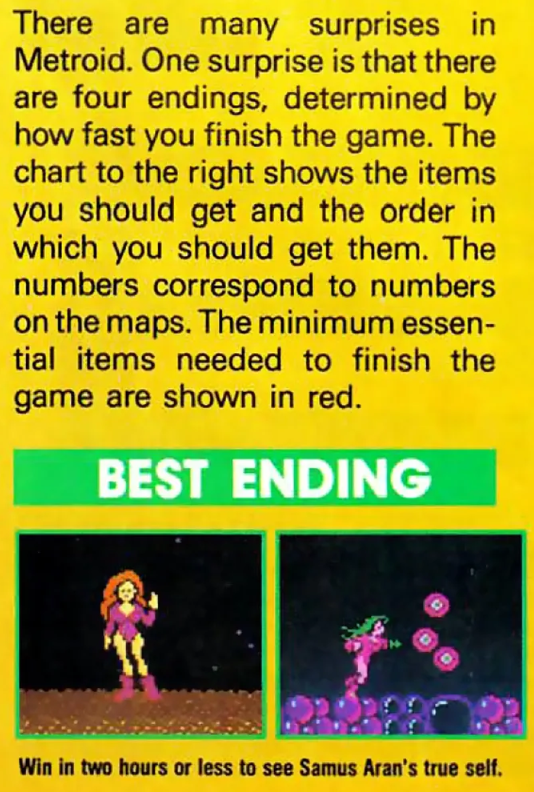
They referred to it as just one of “many surprises”. They didn’t treat it as the big, cathartic revelation it’s now retconned to be, because it really wasn’t. Not in 1986, not in 1987, and certainly not in 1991.
 Nick Enlowe