
Join me on a reread of the Uncanny X-Men and we’ll uncover many mysteries, such as what the X-Men really stand for, and whether or not Iceman’s actually gay.
It’s September 1963. Mary Kay invests her last $5,000 in an upstart cosmetics corporation, risking it all. The first ever 30 minute broadcast of CBS Evening News airs–the first news program to extend itself from 15 minutes to a full 30–featuring Walter Cronkite interviewing President John F. Kennedy, who will soon after propose a joint effort with Russia to reach the Moon, a proposal which will fall flat.
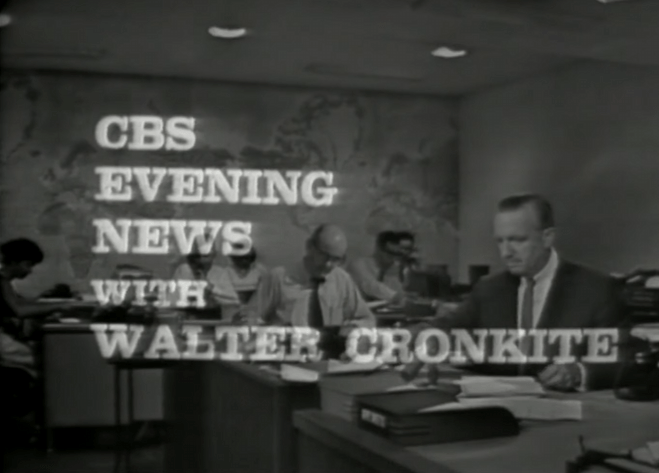
1 week later, NBC will follow suit with its own half hour news program. It’s only a matter of time before ABC does the same. But this month, ABC manages to premiere both The Patty Duke Show and classic science fiction anthology The Outer Limits, further cementing its influence over U.S. culture.
The news is headlining a noticeable amount of racial division and hate, reporting on suspiciously well-timed hate crimes to help sway public opinion so the Senate can push radical bills unopposed, as it always has.
The total effect creates this illusion that the kind neighborhoods you grew up with and loved in the 1950s were secretly reenacting Harper Lee’s 1960 novel To Kill a Mockingbird behind closed doors, which, rumor has it, was actually ghostwritten–or at least heavily assisted–by none other than Truman Capote. (But even in 1963, we’re not allowed to say such a thing.)
On the bright side, minimum wage was just raised to $1.25, twelve cents of which could buy you a nice new copy of Uncanny X-Men #1.
Having already written characters with complicated backstories like Spider-Man and Fantastic Four, Stan Lee was hoping to simplify things a bit with the Uncanny X-Men. This was a story where characters with cool new mutant powers could simply be dropped in on a whim, in a plug-and-play environment. Something easier to write. A throwback to comic books the way they used to be, before Marvel changed audience expectations.
And its lukewarm reception reflected that artistic choice. The series was on life-support by issue 66, falling into reprints after a 7-year run, only to make a huge comeback through a miracle revival five years later with 1975’s Giant-Size X-Men #1, where the team looks and feels more like the X-Men most fans know and love today.
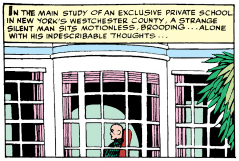
On the very first page of the first issue, the world is given its first glimpse of Professor X in his X-Mansion. And a few panels down the page, his students: Cyclops, Iceman, Angel, and Beast make their debut.
Right away, you may note several peculiarities. Dr. Hank McCoy (Beast), for example, is just a barrel-chested guy with big feet and does not yet have his blue fur.
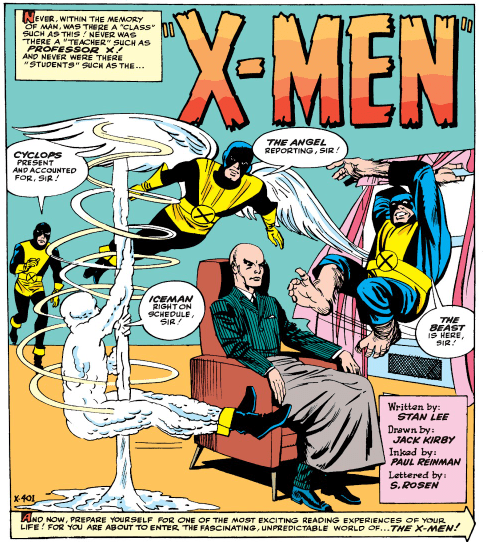
Bobby Drake (Iceman) is quite literally a snowman. This… rather silly look will go away as Bobby gains more control over his powers, but for now an old silk hat and corncob pipe would probably complete his look.
Warren Worthington III (Angel) and Scott Summers (Cyclops), on the other hand, are looking like their normal selves. (It’s a bit hard to tell in this first panel, but Cyclops does indeed have on his famous optic beam visor.)
But this panel does make matters worse for Bobby, as while the 1963 readership would have certainly thought of firemen sliding down a fire pole as a means to rush to an emergency, today’s “progressive” readership looking for excuses to make Bobby gay will look at this panel and draw parallels to pole dancing.
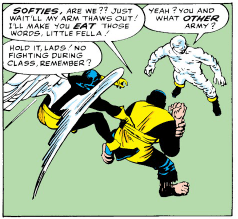
But Bobby quickly asserts male dominance by calling the other students a bunch of “softies”, proving he’s ready to throw down.
We get our first glimpse of the Danger Room and see how well-trained these guys are at fighting, although they have issues with teamwork and grandstanding, and it’s clear they have a long way to go toward mastering their powers. They are honing their skills, learning new tricks as they go.
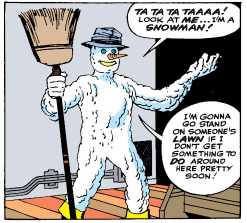
Bobby feels like Professor X is going too easy on him for being the youngest X-Man, so he decides to be the “kid” of the group and even owns the whole Frosty the Snowman schtick.
After Hank and Bobby goof off, dangerously hurling around a bowling ball, Cyclops steps in and gives them a well-deserved reaming. Then, at Professor X’s request, Cyke adjusts down his optic visor to “stun” instead of “kill”, and blasts both of them into the wall. Bobby gets the last optic blast and is pinned to the wall in humiliating fashion, only to get into a scuffle with the rest of the X-Men.
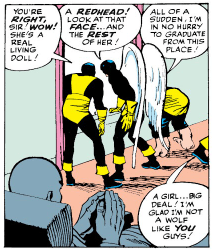
Immediately after, a cab pulls up. And thus begins the controversial panel that progressives most often point to as the definitive evidence that Bobby has been gay from the start.
Iceman, who had just been blasted by Cyclops and attacked by the other X-Men, gets a bad, 1960’s kid-like attitude when they all rush to the window to see the seminal redheaded psychic, Jean Grey. (We also need to keep in mind that Iceman hasn’t actually seen her yet.)
So is this panel proof that he’s gay? Not exactly, but it doesn’t help his case, either. I’m sure Stan Lee and Jack Kirby never imagined Iceman’s first appearance would be held to such scrutiny sixty years later, or they might’ve been a bit more fastidious here. Iceman is acting a bit like how I’d expect Superboy to act in a 50’s-60’s comic with this attitude. It was part of the culture back then.
But most progressive readers only see this panel through the filter of some VICE article, or actually do see it within the context of this very comic but don’t bother reading past issue one, or even past this panel. Mainly, they just want to let their confirmation bias take hold. For progressives like Brian Michael Bendis, this panel’s existence was the only excuse needed to turn–and keep–modern Iceman gay; Bobby’s behavior in future issues be damned.
Oh, you don’t know Brian Michael Bendis? He’s the piece of work that gave the world the overrated Jessica Jones, the incredibly irritating Riri Williams, and was even the co-creator of Miles Morales with Sara Pichelli. He’s heavily responsible for the garbage state modern comic books find themselves in today… and he has the Eisner awards to prove it.
None-the-less, the world gets its first glimpse at Jean Grey in issue #1 as well.
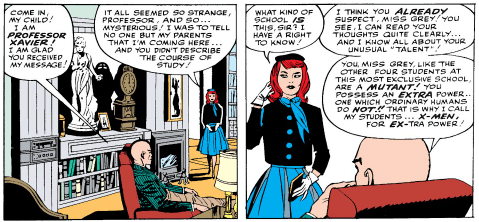
Jean Grey. Marvel Girl. These are the humble beginnings of the girl who would later become Phoenix and Dark Phoenix, absolutely rocking the comic book world as the lynchpin of Chris Claremont’s legendary run.
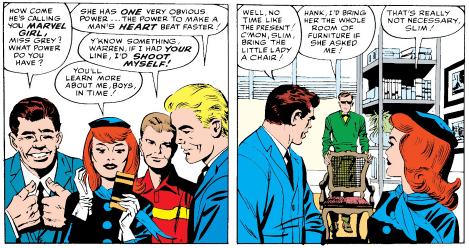
All the boys are into Ms. Grey right away, Bobby included. Cyclops, appropriately, is especially taken by her, saying he’d “bring her the whole room of furniture if she asked”, foreshadowing their coming romantic relationship. Jean decides refer to Cyclops as the very 60s-ish nickname “Slim”, and will continue to do so in near future.
After an impressive telekinesis demonstration courtesy of Marvel Girl, Professor X explains their mission. He explains that some mutants hate mankind and want to become their rulers. It is the X-Men’s job to ensure that humans and mutants get along peacefully.
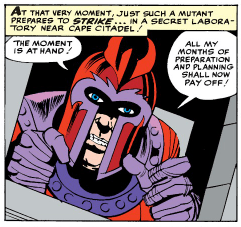
Enter Magneto. That’s right. One of Marvel’s most famous villains also made his debut right here. What a legendary issue!
Magneto, calling himself “Homo-Superior”, is about to show those homo-sapiens what-for by ruining their missile launch from the sanctity of his secret lab, in true mustache-twirling fashion.
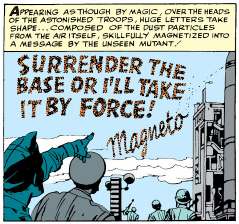
He then attacks soldiers by turning their own metal weapons against them, and even takes to some sky writing, complete with a cursive signature. A very 1960’s villainous touch.
When they resist his threats, Magneto leaves his lab and marches into the military base itself, taking on the soldiers and base defenses single-handedly, proving that being a master of magnetism is a stupidly powerful mutant ability. There’s a reason he’s still formidable to this day and is known as perhaps the X-Men’s greatest adversary.
Had Brian Michael Bendis bothered to read further into issue 1, he would have come across this panel.
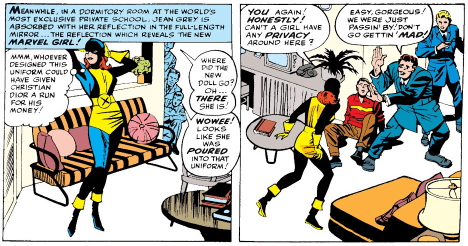
Jean Grey is trying on her uniform, and who should go peeping around the corner but Bobby, Hank, and Warren. Bobby even says, “Wowee! Looks like she was poured into that uniform.” I… think the writer’s intent is pretty clear regarding Iceman’s sexuality. In fact, this panel is the perfect counterargument to the one leftists always love to point to, and it’s in the very same issue.
Soon after, the X-Men have their first throwdown with Magneto. His reaction:
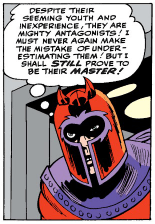
Rather ominous foreshadowing.
None-the-less, Magneto escapes, the X-Men save the military base and are congratulated on a job well done, Bobby the Snowman is vindicated, and Professor Xavier calls them all home.
 Nick Enlowe