THE INFAMOUS SWAMP
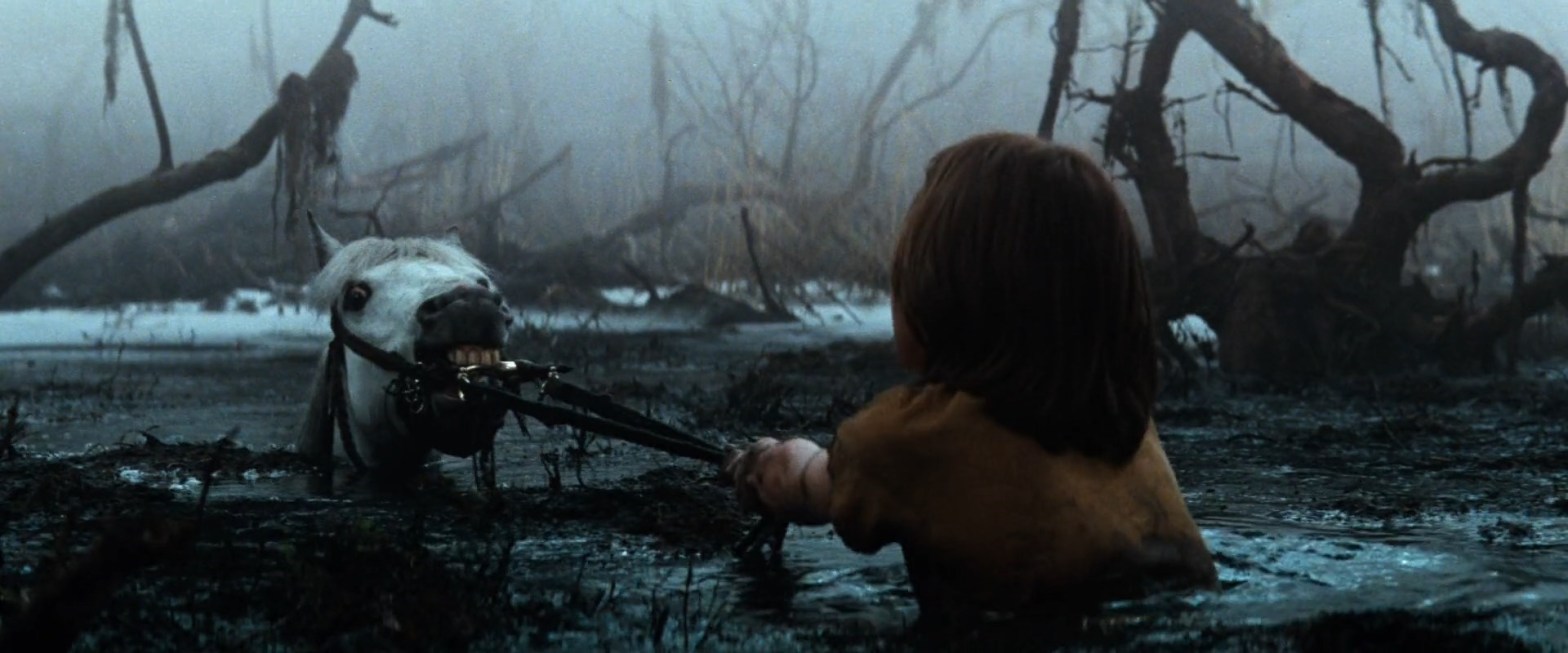
We all know the story by now–As the pair trudges through the waist-deep swamp, Artax seemingly gives up. This beautiful white horse stops moving forward. He has let the sadness overtake him. He’s given up.
Atreyu begs Artax to move, to fight against the sadness that envelops him.
Atreyu: Fight against the sadness Artax. Artax, please. You’re letting the sadness of the swamps get to you. You have to try, you have to care. For me, I’m your friend, I love you!
But Artax can’t overcome the grief and ultimately lets it consume him.
Another Fourth Wall Break?: Atreyu wasn’t just talking to his horse; It’s almost like he was talking to Bastian, the reader of the book, practically begging him to overcome the grief of his mother’s death.
A direct communication or not, it serves as a dire warning to Bastian: Will he continue to wallow in his depression and ultimately die from his own inaction?
It seems if he doesn’t find a way to overcome this sorrow consuming him and get some forward momentum going in his life, the Swamp of Sadness will one day swallow him up, just as it did Artax.
His future, his potential, will be gone.
What’s more, it seems Atreyu, the “Warrior of All”, might even be talking to us, the audience. But just like Bastian, at this point we’re probably going to chalk this one up to coincidence. After all, it’s just a metaphor, right? Atreyu talking to us? That’s impossible.
But one thing’s for sure: A place like this is dangerous. It can swallow your dreams and maybe even swallow you.
Depression can be so dark, so lonely, that even if loved ones surround you and try their best to pull you out of it, it can still prove too difficult to overcome. In the end, it’s up to you to pull yourself out of your own depression. You have to find a way to care. You have to try.
Book vs. Movie: In the book, Artax can talk. Which would have ruined this scene. It may have been another point of contention between Ende and Petersen, but once again Petersen made the correct call.
Modern Lens: There’s no doubt this is a tremendously sad scene. Partly because Hathaway delivers his lines so impassioned that it stings the heart, and partly because of the simple innocence, trust, and loyalty the horse seems to exude as it sinks into the bog.
(In case you never heard, the horse did not die during the filming of this movie. That was a false rumor. In fact, the horse was gifted to Noah Hathaway after filming concluded.)
But this scene asks the viewer to find a way to get past his own sorrow in order to grow up. So it’s a bit ironic that so many have been stuck on this scene for the last 40 years to the point where, to this day, it’s popular to say this scene “ruined your childhood”. In fact, many frame their analysis of the story’s meaning entirely around this scene.
And at this point, people would be forgiven thinking this movie is simply about Bastian’s battle with depression. And that The Nothing is a literal manifestation of the depression trying to consume him.
G’mork’s own words much later in the script even support this theory:
“It’s the emptiness that’s left. It’s like a despair, destroying this world.”
But I assure you there’s more to The Nothing than that.
Book vs. Movie: The point is, this scene resonates much more powerfully in the movie than it did in the book. Artax silently sinking into the bog, unable to express himself as his dear friend is forced to watch. It’s emotionally crushing, and one of the most memorable and iconic scenes ever put to film.
(In the book, Artax dies offscreen after asking the green-skinned blue-haired Atreyu to leave him in peace. Just doesn’t have the same impact.)
THE DIFFICULT TASK OF MOVING ON
Atreyu treks on through the Swamp of Sadness alone, broken up. He’s lost his traveling companion. His friend. He may not even be able to make it back home anymore.
Bastian finds himself relating to Atreyu’s pain and weeps bitterly. Even though the two boys are from different cultures and backgrounds, Bastian can sympathize–maybe even empathize–with Atreyu.
Losing someone to depression has a fallout which affects everyone around. Especially those who tried to pull the person out of the depression and failed.
If you’ve ever tried pulling someone out of a depression, you might have found out the hard way that, more often than not, you end up getting dragged down into the Swamp of Sadness right along with him.
And if the depressed person should die, that failure, that loss, resonates with everyone who must live on without the departed. It leaves behind a terrible dark cloud that never disperses.
The Nothing is a nebulous villain, but experiencing such loss on a personal level helps the audience better understand what’s at stake. It’s the same for Atreyu – Losing Artax has given the young warrior more resolve than ever to defeat The Nothing and save Fantasia.
Modern Lens: It seems audiences now-a-days demand to see themselves “represented” in every story. This is narcissistic. Readers used to be able to relate to any character of any culture, thanks to the shared human condition. It’s sad we lost touch with that somewhere along the way.
MORLA OF SHELL MOUNTAIN
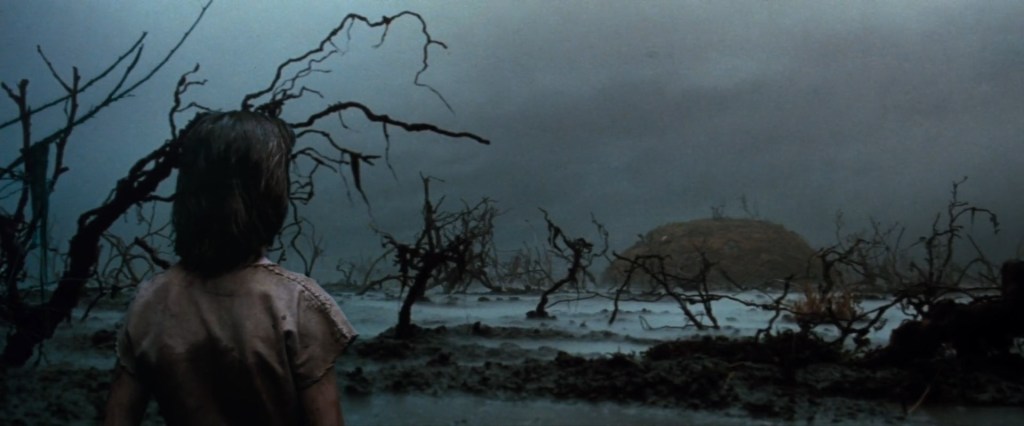
With renewed fervor, Atreyu presses on through the swamp and his diligence pays off in the form of a large hill. The sole reason he came to the Swamp of Sadness was to find “Shell Mountain” and speak to “Morla the Ancient One”, the wisest being in all Fantasia.
When he climbs the mountain and calls out Morla’s name, the mountain moves and sends Atreyu tumbling. This “mountain” was Morla’s shell.
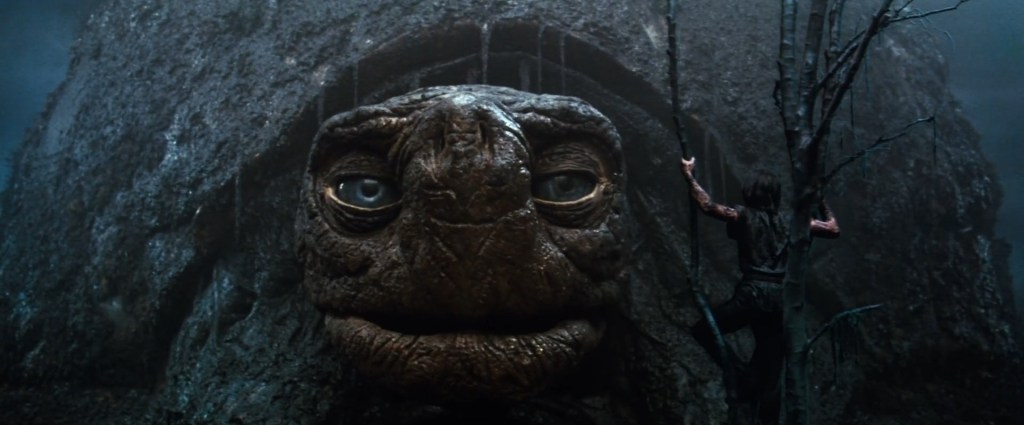
What happens next is fascinating from a narrative point of view: Bastian yells aloud in terror and his voice echoes into the scene of the book itself. Both Atreyu and Morla seem to have heard the reader’s scream and are put off by it.
This is a reverse fourth wall break. Bastian’s voice has now become a part of the story.
Bastian: But that’s impossible! They couldn’t have heard me!
With no explanation for what they had just heard, Atreyu and Morla carry on as if nothing happened.
But Morla’s disposition matches that of his surroundings. He’s a depressing nihilist who believes nothing matters.
After having lost Artax, Atreyu is full of resolve and has little patience for such nonsense.
Atreyu: If I don’t save her, she’ll die! There’s a terrible Nothing sweeping over the land. Don’t you care about that?
Morla: We don’t even care whether or not we care.
Morla is so nihilistic, when he’s told he will die alongside everyone else, he says he’s looking forward to the end of the world. “At least death would be something.”
It’s only after Atreyu outsmarts the ancient turtle that it coughs up information about the “Southern Oracle”, an entity who may know what to do to save Fantasia. However Morla assures Atreyu it’s a hopeless endeavor, as it’s 10,000 miles away. He offers a smug smile, expecting Atreyu to lose hope.
And he gets what he expects – Atreyu begins to doubt himself here. “But that’s so far.”

At this point, the final school bell rings and the children leave for home. It seems time has gotten away from Bastian. But he’s not ready to put the book down quite yet.
The lights of the school are turned off by the custodial staff, the school gets locked up, and a foreboding storm begins.
Bastian is frightened and almost leaves, but finds resolve to stay by channeling Atreyu’s bravery.
 Nick Enlowe
2 thoughts on “How The Neverending Story inspired me to write: Part 5”