Realistically, Bastian’s dad will file a missing child report with the police soon. But then again, dad seems to be a bit of a workaholic. Bastian was probably a latchkey kid ten years before it was the “thing to do”.
That’s likely why dad was trying to pressure Bastian into some extracurricular activities in the opening scene.
Well. The school likely at least notified Mr. Bux that his son didn’t show up to school that day. But even back then, it took awhile for the police to mobilize on a missing child report.
Like I said, this attic is Bastian’s time. It’s serving as his “bastion” from the storm, from the life he ran away from. He’s not leaving without answers. That’s why he stayed. He sought refuge in his books, in his imagination, in the bookstore, in the attic, and even under a blanket, hiding from the storm.
Book vs. Movie: Bastian’s full name is Bastian Balthazar Bux. In the movie, it’s pronounced “bucks”. But in the book, Ende makes it clear it’s pronounced “books” which is a bit too on-the-nose, even considering the context of it being a children’s book.
Again, the director made the better call.
Bastian’s also a pudgy, pale kid with glasses in the book, and an insufferable twit. It’s difficult to root for such a character; He isn’t even likeable. I’ll go into more details about this later.
A LUCKY BREAK
In the movie, Atreyu trudges on through the swamp, though his feelings of hopelessness are beginning to make him sink even deeper into the bog, thanks to Morla’s negative influence.
He gets so down in the muck he has to grab hold of low-hanging branches just to keep moving forward.
Suddenly, the sky opens up with bright, colorful clouds and Falkor the Luck Dragon flies down to rescue him in all of his eighties glory. As luck would have it, Atreyu is snatched out of the bog just in time to dodge certain death in the form of a pouncing G’mork, who had finally caught up to the boy.
Fun Fact: Falkor’s name was derived from the Japanese words for luck dragon: “fuku-ryu”.

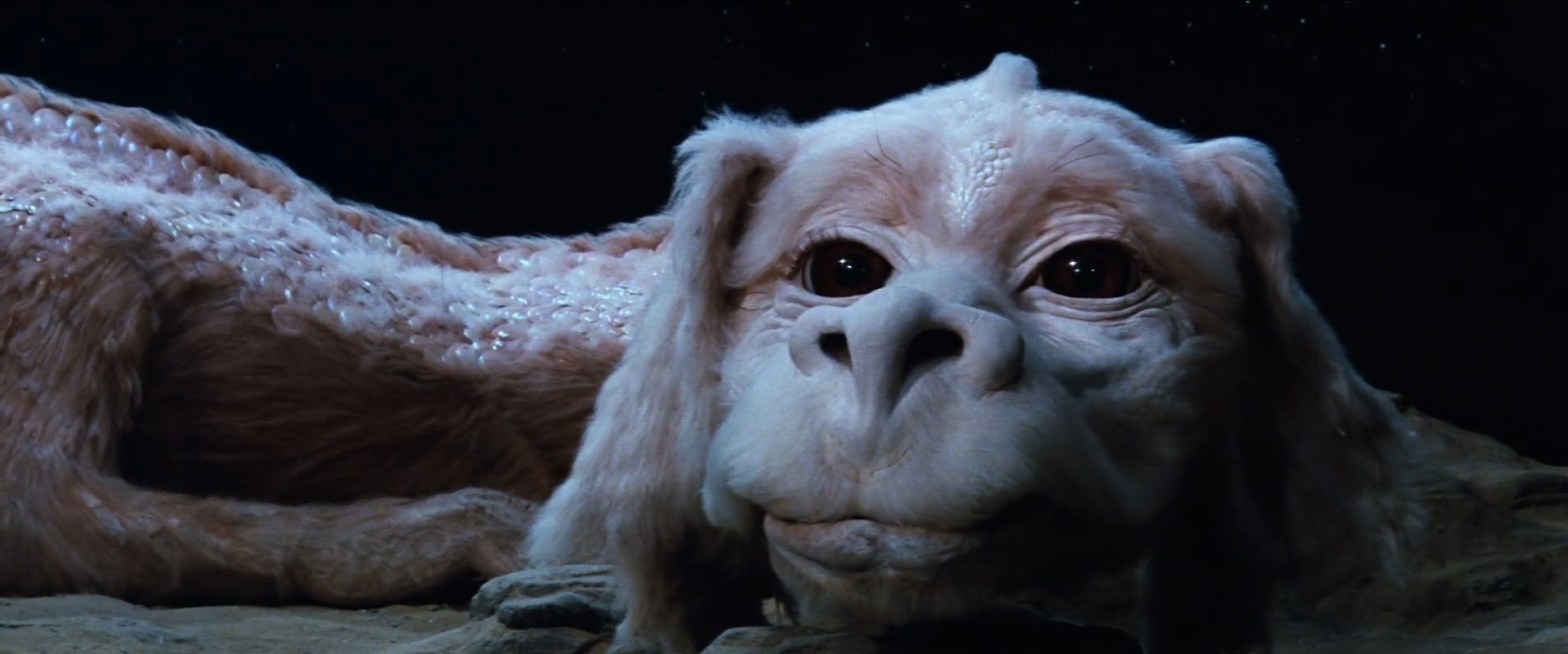
Atreyu awakens somewhere peaceful beneath a starry sky, in Falkor’s gentle embrace. The luck dragon’s floppy-eared dog-like appearance is iconic and instantly lovable.
Conveniently, Falkor knows all about Atreyu’s quest because he was “talking in his sleep”.
Not only that, Falkor reveals he has already brought Atreyu 9,891 miles out of the 10,000 needed to reach the Southern Oracle.
This all sounds like quite a big pill to swallow, but Falkor says it himself:
“Never give up hope and good luck will find you.”
It’s true. If you never give up, good luck has a way of coming your way. Persistence creates what others perceive as “luck”. That goes for any career. Any pursuit.
Occult Lens: 9,891 miles seems like it’s either an awfully specific number or an awfully arbitrary number. After all, why wouldn’t Falkor bring Atreyu the whole way? That leaves exactly 109 miles. The number 109 of course has significant occult meaning. It refers to enlightenment and a spiritual journey with infinite possibilities. Atreyu–and by extension the reader–and by extension the viewers–must make the remaining journey on their own and pass the tests to achieve “true enlightenment“.
Falkor then points Atreyu in the direction of a cave where two gnome alchemists live: Engywook and Urgl. He tells Atreyu these two are friends.
Atreyu is offered a potion that will help “make him well”. And while he’s drinking it, he’s told of the disgusting ingredients that were used to brew it. Atreyu recoils in disgust, but most of it has already gone down the hatch.
YGRAMUL THE MANY
Let’s rewind a tiny bit: This is one of the few instances where the book is better than the movie. So this will be a Book vs. Movie section.
After Atreyu’s encounter with Morla the Ancient One in the book, he ends up in a confrontation in the Dead Mountains with Ygramul the Many, a terrible she-beast who looks like a giant spider. Her body is composed entirely of tiny hornets who share a hive mind which allows her to shapeshift, a spider being her preferred form.
In fact, she’s recently caught Falkor in her web.
Atreyu tries to use the authority of Auryn to persuade Ygramul to let the dragon go free. But to no avail.
He learns if he’s bitten by one of the insects that makes up Ygramul, he will die within one hour, but he can also teleport to wherever he desires most in all of Fantastica.
When he gets bitten, he wishes to travel to the Southern Oracle. But he is led to Engywook and Urgl instead because his heart most desires to be cured, and Urgl has the knowledge needed to nurse him back to health.
The luck dragon follows Atreyu using the magic of the poison, and Urgl is able to cure them both.
These scenes were attempted for the movie, but Ygramul proved too expensive and difficult a concept to pull off with 1984 technology. Once again, probably to Michael Ende’s chagrin.
In this case, Ende’s version works out better and makes more sense. But given the technical limitations and budgetary constraints, what we got in the movie worked fine. It’s whimsical, fits the tone of the story, and better fits the theme of luck that comes with a “luck dragon”.
Speaking of the luck dragon, he looks quite a bit different in the book…
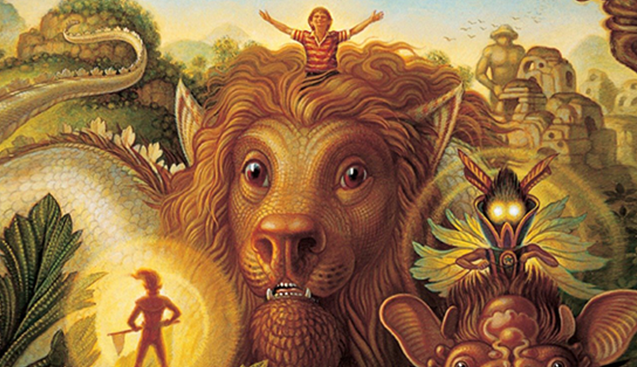
…described to look like a cross between a dragon and a lion with a long, luxurious mane.
In this case, I think the movie version wins again.
 Nick Enlowe