I overheard folks conversing about how they use AI for just about everything these days. Need to write a proposal? A blog post? Need a software mockup? Chuck it to AI and pretend you’re the genius who created it.
You could tell they were profit-minded, business types. And they made fun of people who believe that creating fiction should be more of an artistic endeavor.
The argument went that those types of people clearly have no real talent or else they’d be making money.
If your only goal is profit, you’re merely creating content. If you don’t put heart and effort into your stories, you’re treating your fans as paypigs, taking their time and patronage for granted.
I’ve seen writers achieve similar results utilizing ghost writers, and strangely they always end up becoming prima donnas. They go from being appreciative of the support of their fans to expecting it.
But fans can only be stretched so far before they realize they’re being fed slop and abandon ship. Content is incapable of changing the world. It doesn’t inspire.
There are AI content farms going on as we speak, glutting up Amazon with fake books that are derivative and uninspired. It has made the playing field far worse than ever for new authors who had hoped to crack the market and be discoverable by potential fans.
There’s YouTube vids like, “How to write a book a day with AI (and make $10,000 in the process!)”. There’s an AI-focused channel called “The Nerdy Novelist” where this guy talks about “writing” entire books with the click of a button.
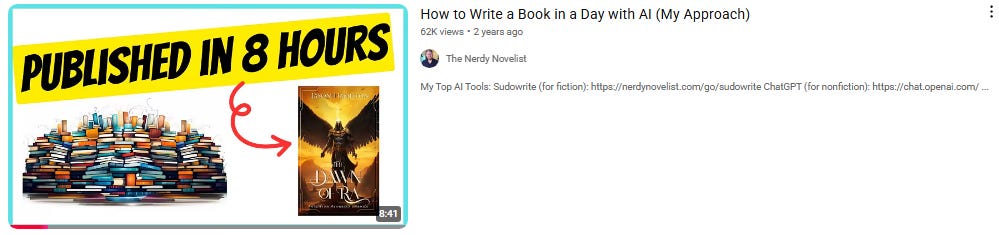
Yet if you ever check out Jason Hamilton’s published books—even discounting the AI tells in the text—you’ll quickly find he has “written” some of the dullest, most unimaginative works of fantasy ever put to page.
AI seems to be nosediving innovation in storytelling. Large Language Models are not designed to look at the great writings of the past and figure out where we go next; they are instead designed to find the most middle-of-the-road, mediocre, predictable word choices on a probability scale and hope it sounds good enough.
Fantasy was already struggling with innovation as it was, thanks to the “AD&D-ification” of the genre. But AI will happily suggest the most milquetoast, safe, proven ideas and build out a predictable Save the Cat storyline for you.
For better or worse, people are offloading their workload to this tech an an alarming rate. If people didn’t trust indie before, they’ll definitely not trust it now that half of the authors are cranking out works using AI.
Look, I get that there’s an “adapt or die” mindset with this kind of emerging technology. But do we really need to hand so much of the process over to the machine?
The internet is truly dead, folks. Most blogs have AI-generated content and are not worth your time. Most interactions on social media are with bots. And for situations where they’re not, how would you honestly know?

I’m glad I’d gotten a few pieces of fiction out into the world before the AI takeover. But it does make me wish I’d pulled the trigger on publishing sooner. Guess I let all the rejections over the years get to me too much.
But the AI conversation triggered a revelation that hit me like a ton of bricks: Writing is supposed to be fun. Somewhere along the line, I’d forgotten that creating a story is a pleasant, enjoyable experience.
That’s what people who let probability calculators write for them are missing out on: Handing off major parts of story creation to a virtual assistant treats writing as if it’s not worth their time. Not only do they cheat themselves out of the magic of the process, but their tales enter a Faustian bargain with a machine, the stories losing their souls as a result.
 Nick Enlowe
AI, specifically Chatgpt, has the same, boring, stylistic writing. I can tell this blog post was written with heart.
LikeLike