
Welcome to the natural continuation of my previous post, and an earlier post about ideation–and the very value of ideas.
The question of focus for this series is perhaps authors’ most classic axe to grind:
“Where do authors come up with their ideas?”
In my last post, I made it clear I’m not here to give snarky answers. I’m here to take this question seriously and offer something practical. A solution you might easily put into practice – even if you feel like you don’t have a creative bone in your body.
I can’t take credit for this answer, but it is the answer I’ve found most true.
THE NOUN GAME … AND HOW TO PLAY
Not all creatives realize it, but when they’re creating and brainstorming something meaningful, they’re actually playing The Noun Game.
The first thing you do is grab a blank sheet of paper and pen, and simply write down a noun. First thing that enters your head.
Could be a person, place, thing, or idea. Fictional or non-fictional.
Still not coming up with anything? Write down the word “The” and see if a noun springs to mind afterward.
Still nothing? If this exercise is proving agonizing for you and you can’t come up with anything after several minutes, good! It means you’re getting some much-needed “creative muscle brain training”.
Come back here once you have a noun written. I’ll wait.
…
Got one written down? Okay.
Now ask yourself if this noun is meaningful to you. Does it resonate with who you are as a person? Does it represent your life experiences in some way? Do you have some sort of emotional connection with it?
If not–if it was a truly random pick or something you wrote down just to be funny and there truly are no deeper answers–cross it off and try again.
And if so, strap in – This is just the first step.
MY FAMILY’S STRUGGLE WITH CREATIVITY
One of my children in particular struggles with creativity. About the most creative he ever gets is creating Roblox stages that are derivative concepts of content other users have made, perhaps bolstered with a sprinkling of memes he’s seen on YouTube.
If I ask him to write a story, it’s often a mishmash of what he did that day (went to the aquarium, grocery store, etc.) where something funny and nonsensical happens. And that’s fine, but he tends to take the first suggestion we give him (wife and I) and runs with it, rather than coming up with an idea himself.
So a few days ago, I had him play the Noun Game. At first, he wrote down things he thought I might want to hear, such as Wizard, and Tower.
I challenged him, asking him to dig more deeply. Think of experiences he’s had in his life, things he’s emotionally linked to.
For example, I might write The Ocean, because for most of my life I hadn’t seen it. I had to imagine what it would be like. And when finally I did get to see the ocean, the reveal was nothing short of breathtaking. So, one’s reaction to seeing the ocean for the first time is something that resonates very strongly with me.
My sweet wife chimed in saying she would immediately write down my name and our children’s names.
I smiled and told her what that really boils down to is “Family”. And maybe even a “familial bond”. A strong, nuclear family and the happiness it can bring resonates strongly with her, and it’s special to everyone in our family. We could all safely add Family to our sheets.
I can almost guarantee the noun “family” resonates strongly with the writers who wrote The Incredibles. And Lilo and Stitch. And The Fast and the Furious.
“Toys” and “Childhood” almost certainly resonate strongly with the writers of Toy Story. Are you starting to see how this works?
RAY BRADBURY’S NOUN METHOD
Some of you may have already realized this is a famous exercise invented and championed by highly prolific author Ray Bradbury, who had published some 600 short stories in his lifetime and wrote incredible classic novels such as Something Wicked This Way Comes.
He’d regularly add to his list of nouns as he lived his life, writing down things like:
- The Carnival
- The Mirror Maze
- The Night Train
- The Trap Door
- The Angry Crowd
- The Merry-Go-Round
And as he would interconnect these ideas, deeply personal stories that only someone who had lived his life could have ever written began to emerge.
You can add adjectives or otherwise bolster these nouns to give them more “character” if it helps. These types of nouns are especially potent kindling for sparking story ideas (and yes, these are nouns from my own personal list):
- The Old Woman
- The Fiddler’s Green
- The Airship
- The Dusty Library
- The Gnarled Tree
- The Broken Clock
- The Overbearing Assistant
- The Haunted Barn
- The Wooden Pinball Machine
CONTINUING THE EXERCISE
I had my son begin a list of ten things he loves. (Strong emotions help ensure resonance.)
He wrote Mexican Food, something I absolutely know he loves.
Then he wrote Chicken. And what’s interesting here is he doesn’t actually love chicken. It’s just something he casually likes. So we put it in parentheses.
He wrote a few more things he loved, which I won’t share here because they began to get more personal.
Then I had him begin a new list of things he strongly hated.
After three or four entries on each list, he felt stuck. And that’s fine.
I had him go do his normal thing – in this case, playing more Roblox. But with a caveat: I asked him to keep the noun list tucked into the back of his mind so he could add more nouns throughout the day, as they occurred to him.
Here’s the secret sauce: Keeping this list in your thoughts while doing something else means you’ll have to let it live in the back of your mind. This is key. If all goes according to plan, his list should grow organically within his subconscious.
This whole Noun Game is a very right-brained exercise. It’s a sort of hack to bypass your stubborn left-brain, to spring ideas forth from your subconscious. Stories grow in much the same way.
So he jotted down more and more nouns as the day went on, and something magical began to happen: His entries started getting more and more deeply personal. The pretense dropped and the entries grew increasingly more right-brained.
After having written…
- a handful of words that emotionally resonated with him
- 10 nouns he loves
- and 10 nouns he hates…
…he ended up with a list that only he could have ever written, something uniquely him. A list that told us quite a bit about not only who he is as a person, but where his values lie.
I had him look at this list and ask himself if he’s ever truly created something that reflects this list, something that reflects who he truly is.
He had to admit that, no, he hadn’t, and began to understand that creating meaningful art is far more than just making stuff up off the top of your head.
(His younger sibling wanted to join in on the exercise, too, and a similar magic happened. So you’re never too young–or too old–for this exercise.)
Stephen King is on record having used Bradbury’s method. He’s written down things like:
- The Clown
- The Fog
- The Ledge
- The Lawnmower
- The Cemetery
- The Smoking Addiction
My son and I started weaving and colliding nouns together, like one might knock flint into steel, and stories began to emerge. They were practically springing from the page, begging to be written.
It’s hard to believe that a simple list of nouns can be so powerful.
This is why I so strongly refute the idea that ideas are cheap – Ideas that bloom from who you are as a person, are priceless.
To continue this exercise, you can add nouns that frighten you, etc. Add as many emotions as you can. Just make sure each noun resonates. And keep adding to this list as if it were your own personal diary. Because it is. Only … more cryptic.
Once your word diary has sufficiently grown, you should find it’s nearly impossible to study your list without sparking a story idea or two that deeply resonates with who you are.
In the previous post, I mentioned Neil Gaiman had said,
“I make them up. Out of my head.”
when explaining ideation to his fans.
That’s only part of the story. Gaiman subconsciously has a list of Bradbury nouns swimming at the back of his head, too. And one can begin to imagine what this list might look like:
- The Fates
- The Abuser
- The Thousand Cats
- The Scatter-brain
- The Graveyard
- The Mirror Mask
- The Mythology
- The Button Eyes
- The Betrayal
PROBLEM OF EXTERNAL FORCES
This is where external forces begin to emerge as a problem.
There are many ways to ensure your story does not resonate. It should come as no surprise that one of those ways is to write something that’s not deeply you.
For example, you might mish-mash two popular ideas and stitch their story beats together, filing off the serial numbers as you go, rebranding famous characters as your own. You’ll end up with Product. Product you can sell. Product that will likely be less than a footnote in the history of literature unless the crossover results in a gimmick so clever, it fools everyone.
And if it does manage to fool everyone, there’s a good chance you injected a lot of yourself into the final product, anyway.
Another example: You might write using a writing or image prompt, and forget to inject enough of yourself into the final product to make it rise above being merely generic.
Or perhaps you’ve been asked to write a continuation of a series you didn’t create, or maybe one that you know has already run its course. Or simply … a series that doesn’t resonate with who you are as a person.
(This is part of why Hollywood has extreme difficulty delivering anything with meaning these days. They churn out content, sequels, and rehashed ideas – not art.)
Worst of all, you might ask AI to generate ideas for you. This is bound to create stories which have almost zero resonance with who you are.
Imagine asking AI to give you a list of nouns that deeply resonate with you. The AI will crank out a huge list of nouns, no doubt, but they will be random. And they will be things the AI thinks you want to hear because it doesn’t know your life. And even if you were to train it to know your life, or tell it your life story (PLEASE don’t do that), it still hasn’t lived your experience and can’t begin to understand the nuance and subtleties of who you are.
The Nerdy Novelist can be seen on his YouTube channel typing prompts like, “Give me a list of epic fantasy story ideas.” The AI belts out generic throughline after generic throughline, and Nerdy randomly picks the one that he thinks sounds best and goes with it.
Here, Nerdy is writing a profoundly deep and personal exploration of his own battle with food addiction. A serious subject, to be sure.
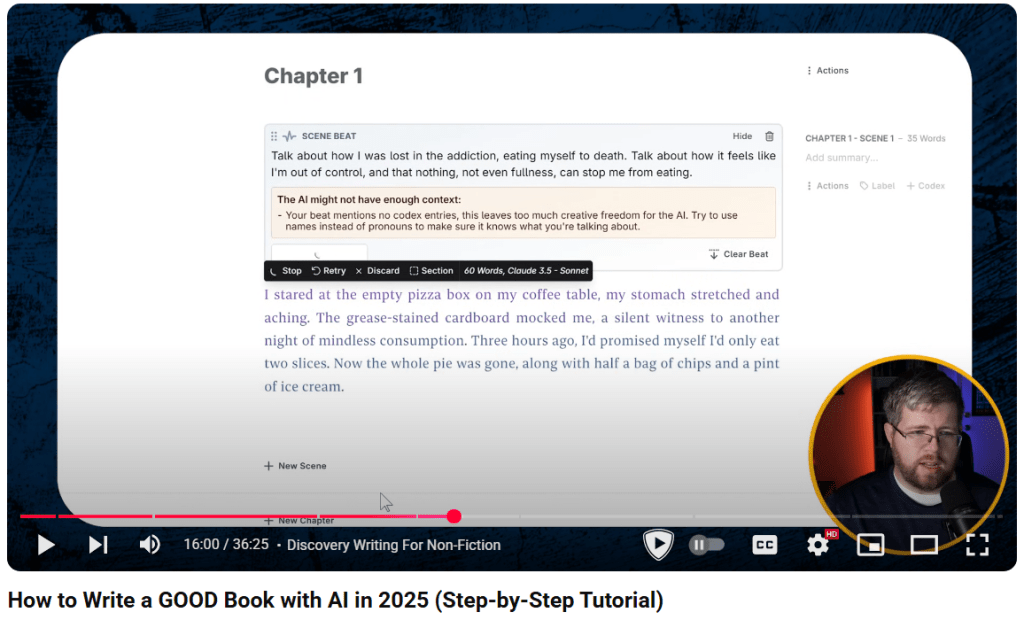
…Please read that screenshot carefully.
Do you see the problem? Not only does he believe he’s writing a “GOOD” book, but none of what he generated was personal. At all. Instead it’s cold. Impartial. Distant. It’s words cosplaying as if they were deeply personal. It’s a fake scenario cosplaying as if it had been lived in real life by Nerdy himself.
It’s disingenuous because he’s trying to sell this scene to the reader, getting them to believe he really wrote those words from deep within his heart in a vulnerable, emotional state during a particularly tough time in his life. That he really was there staring at that empty pizza box one morning, clutching his stomach in agonizing pain.
But all he actually wrote was the prompt at the top in the gray box that begins, “Talk about how I was lost in the addiction…”
The AI, meanwhile, is trying its darndest to manipulate reader emotions into believing Nerdy has not only lived through this, but felt genuine sympathy while writing it.
If an author had actually gotten over a serious food addiction and was trying to market his book toward emotionally vulnerable people who are still suffering, I think he owes it to them to share his own personal experiences, not imaginary ones cooked up by a machine.
The fooled reader thinks the author can relate to what they’re going through. And maybe he can. But this scenario is merely what a particular LLM thinks a human food addict might want to hear, much like how a $5 psychic operates at the county fair.
Or I could compare it to writing an AI speech for cancer patients.

The problem with letting AI dictate your stories is that the noun lists it writes from are random and inconsistent. They’re noise. Thus, very little of what you create with AI will tell me a thing about who you are as a person.
An LLM couldn’t have possibly cranked out meaningful, deeply personal pieces like Something Wicked This Way Comes, or Coraline, or Toy Story, or even this blog post. It’s a meaningless content machine.
I guarantee you Bradbury’s turning in his grave. And Nerdy is robbing himself of a lifetime of meaningful art, instead churning out Product in an age that already has too much of it.
Well, let’s end on a positive note: Play the Noun Game! Free yourself! Deshackle from those many external sources and distractions that can rob real meaning from your works. I highly recommend it.
 Nick Enlowe