
Leigh Brackett should need no introduction–She was a powerhouse in the industry whose absence is still felt today.

Sadly, the world lost her in 1978, but not before she managed to finish the first draft of The Empire Strikes Back, one of the best films of all-time.
She was a behemoth on the short story/novel front, too, regularly landing the featured cover story over such heavyweight contemporaries as Ray Bradbury and Poul Anderson.

She even holds the honor of having written the final featured tale for the very last issue of Planet Stories.
The interviews from that time are all positive and uplifting. I perceived no jealousy or contempt for one artists’ successes over another. It was all for the love of the craft. (A far cry from the unnecessary Booktube drama we so often see today.)
The evidence of that professional camaraderie can be seen clearly with this issue, where she co-authored the featured tale with Bradbury, who also served as best man at her wedding.

Needless to say, Brackett has left behind quite a legacy which inspired many. Her accolades run deep, such as working with William Faulkner to pen the screenplay adaptation of Raymond Chandler’s novel The Big Sleep, starring Humphrey Bogart and Lauren Bacall.
If you’ve never read Brackett before, her 1949 novel The Sword of Rhiannon will probably surprise you. While it certainly has dated elements, it reads surprisingly modern thanks to its fast pace, its tongue-in-cheek humor that still lands today, and its deep and immersive 3rd-Person Limited perspective.
Its tone is what you’d wind up with if you crossed Indiana Jones with Star Wars, making it easy to not only see how heavily Brackett’s storytelling influenced both George Lucas and Stephen Spielberg, but it can help you understand exactly why Brackett was fingered to write for the Star Wars franchise in the first place.

The Sword of Rhiannon was originally printed in Thrilling Wonder Stories as “Sea Kings of Mars” in 1949. But why the title change?
It seems at some point between 1949 and 1953, the public’s perception of Mars had shifted. Ace books felt that, due to “recent” scientific and astrological “breakthroughs”, the public was starting to believe there couldn’t have ever been life on Mars, and that the planet simply could never have been “wet”.
Well, we know today there’s plenty of evidence water did exist on Mars, which just goes to show how wrong and full of hubris the scientific community can often be, and how easy it is for scientists to sway public opinion.

But the damage had been done. Mars was considered passé for science fiction and science fantasy alike overnight, and our nearby planetary neighbors were considered as cold and dead as any Carl Sagan quote.
So it’s interesting to see how much respect Brackett heaps onto Science during this tale (yes, Science with a capital “S”), only for Science to turn around and stab her in the back, hampering the creative space allowed within her favorite genre.
That trend continues to this day, with critics jumping down SF writers’ throats if they don’t neatly adhere to current and established science dogma.
But fortunately for Brackett, this book is Science Fantasy like Star Wars, which meant there was a teensy bit more wiggle room.
Ace just had to make sure they didn’t frontload the Mars “pseudoscience nonsense” before Brackett could hook potential readers with her otherwise solid prose.
So in 1953, Ace released her book as a double feature with Robert E. Howard‘s Conan the Conqueror, the only Conan full-length novel REH ever completed.
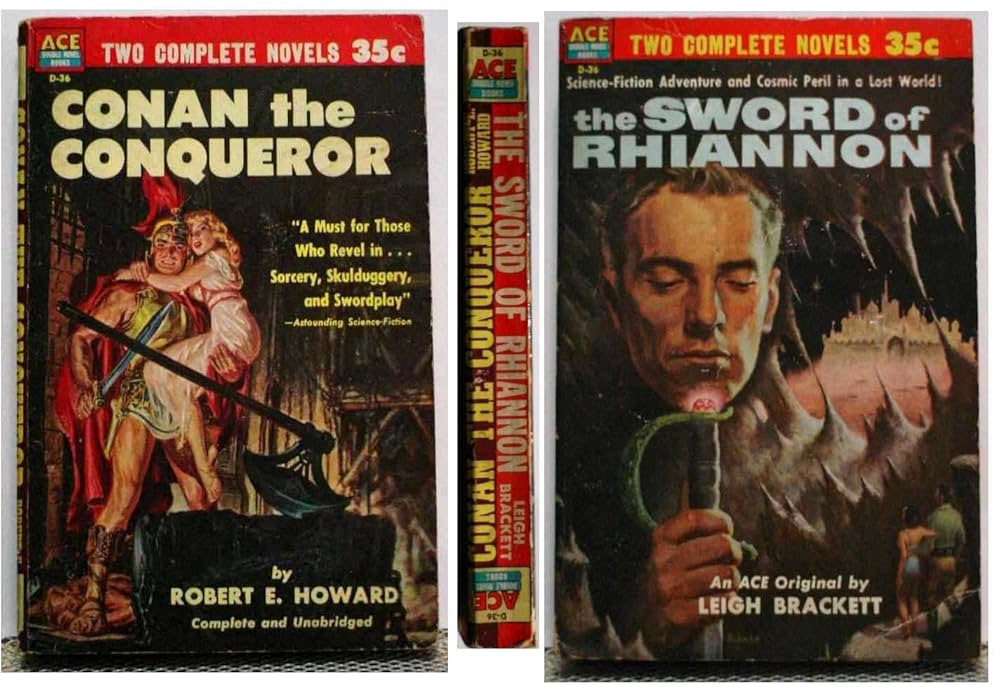
This was huge for her career. Many Brackett fans experienced her prose here first, despite her already having a backcatalogue of about 50 publications under her belt.
The main character of The Sword of Rhiannon is intrepid adventurer Matthew Carse, who feels like a prototype cross between Han Solo and Indiana Jones. He’s roguishly handsome and clever; a former archeologist who’s reluctantly turned to a life of crime.
In the seedy backalleys of the Martian city Jekkara, he’s been tipped-off to the location of the legendary Sword of Rhiannon, an ancient artifact that has great archeological value.

So we start off this tale with a bit of tomb raiding in a scene straight out of Indiana Jones. The setting? A far future where Earth has colonized Mars…
…which doesn’t seem so far-fetched these days, does it? Not in a time when SpaceX has been running tests for manned flights to that very planet.
Science Fiction and Science Fantasy, at its best, can be prescient. If we allow writers to write about the future without adhering strictly to Settled Science, these stories can help predict what may one day happen in the far, far future. It’s all about unleashing the imagination, not about pigeonholing genres and locking down science to what we think we know now.
Regarding the name Rhiannon, my wife and I couldn’t get this song out of our heads every time we sat down to read another chapter:
It’s a good song, but it can be annoyingly infectious. Came out in 1975, just two years before Star Wars and three before Brackett was lost to cancer. So it likely had time to wiggle into her ear as well. And that might be a good thing–She seemed to have a strong affinity to the female Welsh name.
For example, she once wrote a story called The Sorcerer of Rhiannon, in which “Rhiannon” referred to a chain of islands.
But in this tale, “Rhiannon” is the name of a male god, a member of the “Quiru”, a super-intelligent god-like ancient race who had superior Scientific knowledge that set them far above the other races on Mars.
Anyway, Carse works his way into Rhiannon’s tomb, certain he’s being followed by a rival thief. Turns out he was correct, as Penkwar (a sniveling traitor) shoves Carse into a strange black sphere to be rid of him once and for all.
Now’s a good time to mention that the tomb itself is full of Weird fiction elements, a very Lovecraftian flavor. It’s loaded with strange Science-powered artifacts that Carse can’t begin to understand. The black sphere was one of them.
SPOILERS START HERE
It turns out the sphere was a time portal, which sent Carse hurdling back to when Mars was still covered in seas and terraformed, a time only shortly after the Quiru had lost their iron grip on Mars.
This grim timeline is all thanks to Rhiannon, who handed over the Quiru technology to a race of evil lizard people called the Dhuvians. Unfortunately for the rest of the denizens of Mars, much of their Science could be used for war. Thus, Rhiannon is very much like Prometheus, an evil being. But, to his credit, during the story Rhiannon is trying to set things right.
The rest of the Quiru sealed him away in the very tomb Carse was raiding as punishment, naming him “The Cursed One”.
(Yes, this is a portal fantasy. Carse was indeed isekai’d from future Mars to a Mars long past.)
And as Carse wanders this strange, ancient version of Mars, the Martians react to him with animosity in panicked, realistic ways. Things escalate quickly. No one in the Mars of the past has ever seen a human. And it didn’t help that Carse was carrying the sword of the Cursed One along with him.
Fortunately, he happens upon a fat merchant scoundrel named Boghaz who inadvertently bails him out.
Boghaz ends up being one of the most delightful characters in the entire novel. He’s a selfish schemer and comic relief of the foppish kind. His lines would be right at home as C-3PO dialogue, and there are many genuine laugh-out-loud moments because of him.

It’s fun. You know, like The Mummy and Pirates of the Caribbean.

…Why can’t we have fun things anymore?
There’s quite a lot for Carse to contend with and smooth talk his way out of in this piratey world of canals and sea-faring vessels. Ruthless warhawk King Neptune-like rulers want his head, then there’s the reptilian Dhuvians, plus two fiery vixens who flip-flop between wife-material and antagonists at every turn as double-crosses abound, not to mention the ancient gods and a brewing war ahead.
But he’s got the power of Science on his side along with cunning, brute strength, and he’s being skin-ridden by Rhiannon himself as they wrestle for control over his own body.
There’s a moment where the slaves aboard a boat have to find the courage to rise up and become men, fighting back against their slave drivers, even without weapons, and it really gets the adrenaline pumping. Their struggles feel real, the odds seem slim, and their victory feels earned.
I won’t spoil too much more here, but I will say the action crescendos nicely into the final section of the book, with plenty of swashbuckling and magicScience-slinging.
My only complaint about the ending is it promises sweet, sweet revenge on Penkwar (the punk who shoved Carse into the time portal in the first place), only to never get back to that particular plot thread.
CONCLUSION
Solid prose alone makes this book worthy of your time, but some of the magic that once made franchises like Star Wars and Indiana Jones so great can be found here in abundance. I’m shocked this book never got a movie treatment–It would’ve made a great popcorn muncher, at the very least. (And still would to this day.)
What can we learn from The Sword of Rhiannon?
Well, Sword and Planet can feel a whole lot like Sword and Sorcery. It doesn’t always have to be dark and gritty. It can be fast-paced, comedic, and fun.
Try not to prop science too high on a pedestal, and certainly don’t treat it like a religion. Chances are, it won’t love you back in the end.
Furthermore, don’t believe everything you hear from scientists. They don’t have the world figured out. Really, they don’t. And on some topics, they have too much pride to ever admit it.
If you’re a Sci-Fi writer, don’t be afraid to go beyond the limitations of your genre and challenge the bounds of so-called settled science. After all, if science is never challenged, the truth itself could die – Isn’t challenging the reader one of the core purposes of fiction?
 Nick Enlowe