
There are lots of young, liberated female sci-fi authors out there who feel they are breaking down boundaries in a male-dominated field.
Nothing could be further from the truth.
Many certifiably insane people are responsible for getting the world of Sci-Fi and Fantasy literature into the awful mess it’s in today, and James was a key contributor.
If one were to carefully cherry-pick James’ story, it would fit neatly into the narrative that men did not want women in science fiction. But if you look too closely, you might find you’re staring into a black mirror.
The Man, The Myth
Hugo award winner James Tiptree, Jr. (1915-1987) was a prominent and prolific science fiction writer who wrote many feminist short stories and novellas, including the classic short story, “The Women Men Don’t See”, published in Fantasy and Science Fiction magazine in 1973.
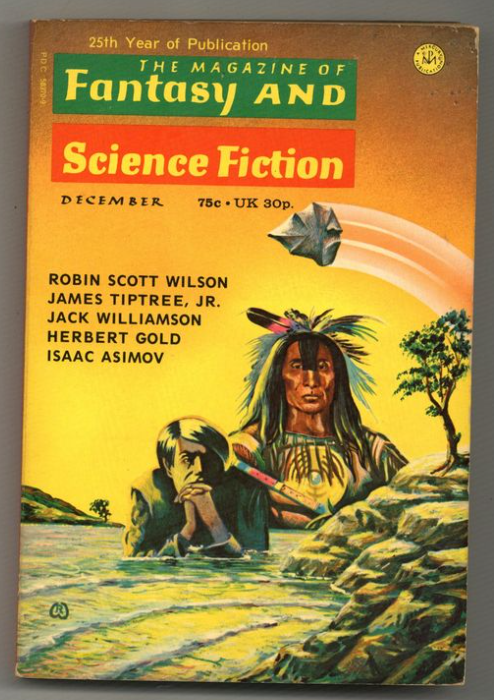
Let’s examine this Nebula and Locus-award nominated story, shall we?
- A man (Don) meets a woman (Ruth) while on vacation in Mexico.
- Ruth and her daughter (Althea) charter a flight and allow the man to travel with them.
- The plane crashes in a mangrove swamp off the Quintana Roo coast.
- Don and Ruth go searching for fresh water, in the interest of survival for themselves and Ruth’s daughter.
- Don becomes increasingly annoyed with Ruth because she keeps a cool head and “does not panic or act in a way he expects of a woman”.
- Ruth grows exasperated and eventually tells Don she feels alienated because she’s a woman.
- Don (rightfully) says he doesn’t understand her views.
- Ruth says, “What women do is survive. We live by ones and twos in the chinks of your world-machine.”
- Instead of a rescue boat or airplane, aliens appear.
- Ruth pleads for the aliens to take her and her daughter away from Earth.
- Meanwhile, Don (rightfully) tries to rescue them from alien abduction.
- The aliens take Ruth and her daughter, leaving Don bewildered and alone on the desert isle.
When asked for deeper meaning in regards to the story and its title, Tiptree said, “Don could only see Ruth and her daughter sexually. They were otherwise invisible to him, except when he thinks of them as potential erotic interests.”
Nevermind that men don’t actually think that way, and men certainly don’t get frustrated when women keep a cool head and don’t panic. In fact, the opposite is true – Men get frustrated when someone does panic in an emergency, no matter their gender.
And doubly nevermind that thinking about someone’s daughter in that way is disgusting.
But how stunning and brave that Mr. Tiptree should stand up for women’s rights in a time when it was so desperately needed.
There’s just one problem. This … was James:

Her real name was Alice Sheldon.
Alice in Jungleland
Alice lived an unbelievably privileged, charmed life, having grown up in the exclusive Hyde Park “intellectual enclave” of Chicago with her wealthy family, and was more well-traveled than Scrooge McDuck himself.
Her father? Herbert Edwin Bradley. Lawyer, naturalist, big-game hunter, zoo director, and real estate mogul extraordinaire. Her mother is perhaps even more remarkable, and I’ll speak on her later.

They were more than just rich–They would travel to places like Egypt to oversee archeological digs and the Belgian Congo to find specimens of rare mountain gorillas for the American Museum of Natural History.

Alice got to be the star character in various travel picture books for children set in exotic locales, and got to attend the “University of Chicago Laboratory Schools”, an experimental teaching workshop, before heading off to finishing school in Switzerland.
“And in the inquiry all sorts of things about Experiment House came out, and about ten people got expelled. After that, the Head’s friends saw that the Head was no use as a Head, so they got her made an Inspector to interfere with other Heads. And when they found she wasn’t much good even at that, they got her into Parliament where she lived happily ever after.”
-C.S. Lewis, from The Silver Chair
Alice eloped to marry her husband at the age of 19, then divorced him just six years later over petty concerns that could have easily been rectified, and the fact that she “disliked keeping house”.

Now “free” at the age of 25, Alice joined the Women’s Army Auxiliary Corps., and then the Air Force as an intelligence officer who interpreted aerial intelligence photographs. During her time there, she was promoted all the way to major, a rare feat and high honor for any military career.
But, oddly, she was quoted as saying she felt she was “among free women for the first time,” regarding this phase of her life.
Following the close of World War II, she met her second husband in Paris.
She got a piece published in The New Yorker called “The Lucky Ones” in 1946, then joined the CIA as an intelligence officer. (You’d be amazed how many of these rabbit holes involve careers in the CIA.)
Then she got her doctorate in Experimental Psychology in 1967 and, during this time, launched a writing career under her false male pseudonym.
Why a male pen name? Biased, low-information sources will tell you it’s because she was worried she wouldn’t be taken seriously by her peers, but this is a bald-faced lie to perpetuate the narrative. She never said such a thing.
On the contrary, she’d already gotten published many times and seen success using not just two or three, but five separate female pen names. Instead, it was because she felt she’d experienced too much success and too many accolades as a woman:
“I’ve had too many experiences in my life of being the first woman in some damned occupation.”
-Alice B. Sheldon, on why she DECIDED TO WRITE fiction under a male pSEUDONYM.
That’s right, she was sick of being celebrated and given accolades, because it didn’t make sense to her given that the world was so… sexist against women… right?
This false persona, this lie, put publishers in a precarious situation. They had to assume Alice’s gender due to the pen name, of course.
But it’s really the same situation as the Metroid conundrum I wrote about earlier. Blatant, purposeful lies about gender to gaslight victims now, then rewrite history later.
Even back then, some in the industry were savvy enough to have suspicions the author was female, only to be dismissed as “sexist”.
But they had good evidence, due to the fact that the name “Tiptree” was widely used as a pseudonym, that the writer had never made any real life appearances, and due to the subject matter and style of her writing.
Now-a-days, these kinds of suspicions would be written off as “conspiracy theories”.
But never fear! Grandmaster of Science Fiction, Hugo, and Nebula award-winner Robert Silverberg rode to her rescue as a white knight, saying:
“It has been suggested that Tiptree is female, a theory that I find absurd, for there is to me something ineluctably masculine about Tiptree’s writing.”
Either Silverberg knew the truth and was running defense, or he’s gullible and doesn’t have enough writerly instincts or talent to pick up on the subtleties and tells from Tiptree’s writing.
Silverberg’s 90 years old now, but still alive and kicking. (Hi, Robert!)
In Alice’s letters to fans (and to other writers including Ursula K. Le Guin), she presented herself as a “feminist male”. Her stories were all themed around “a way to escape a male-dominated society” and were aggressively focused on gender identity.
For example, “Houston, Houston, Do You Read?” is a short story about how males were wiped from the population of the Earth, only for females to take over and get along just fine, carrying on the human race through peace and cooperation.
Now, at this point, I want you to reflect on how absolutely charmed her life has been. How she was born with a silver spoon in her mouth, how she saw success in publishing over and over, how she was promoted all the way to major, and how she found nothing but skyrocketing success in every career she touched.
So, what did she mean by a “male-dominated society”, exactly?
A Heritage of Female Literary Success
If her own incredible success in publishing wasn’t evidence enough to prove that the industry wasn’t sexist, her mother, Mary Hastings Bradley (1882-1976), was also a prolific, award-winning fiction writer. She belonged to the Society of Woman Geographers with such peers as Eleanor Roosevelt, Margaret Mead, and Amelia Earhart.

It was Mary’s 1976 obituary that inadvertently outed her daughter as the the true identity of the famous James Tiptree, Jr.
And that connection was only made because Alice foolishly wrote in a letter that “his” dear mother had just died in Chicago who was also a writer, and fans connected the dots.
Discovered, she immediately wrote an apology letter to Ursula K. Le Guin, who I’m sure was delighted, since Le Guin herself was a feminist.
And Robert Silverberg ate crow.
Being outed as a woman didn’t stop her. As shortly after, she published her first full-length novel, Up the Walls of the World, under her real name through Doubleday.
Thus ended her twisted psychological gender experiment with the publishing industry. It’s amazing how much damage a lie can do to the moral fabric of society, just for a “told you so” moment. There was a demand for sexism, so she created the supply.
Now feminists glibly write about Tipton, making fun of any male writers who (rightfully) misgender her based on her pseudonym. Her stories are still reprinted and celebrated today.
I want you to think about her life, because the conclusions she drew from it make no sense. In a vacuum, the only way to come to the philosophies and conclusions she had is through a dreadfully bitter contempt toward males … even though the men–and women–in every industry she ever entered … had always welcomed her with open arms.
It’s like she was looking for sexism where there was none. And it got her so angry, she had to create it herself wholecloth.
So for ten whole years, she wrote under a male pen name as people dared assume her gender because her pen name was male. And she could have gone on much longer with her lies, had she not been accidentally outed.
But it starts to make sense once you realize there was an external factor at work–school indoctrination.
Alice got wound up in the Second Wave Feminism movement, mainly launched by Peoria, Illinois native Betty Friedan who had written a direct attack on the nuclear family with her bestseller The Feminine Mystique. This book led to the passing of several unjust laws and the founding of NOW, the National Organization of Women.
We are still suffering the consequences of this poisonous book to this day.
(It should be noted that Eleanor Roosevelt, who I mentioned earlier as a member of the Society of Women Geographers with Alice’s mother, was also a huge proponent of this movement.)
A Tragic and Miserable End, and a Legacy that Continues
In her final years, she suffered from depression.
By 1976, she had written a letter saying she wanted to commit suicide to end it all.
In 1977, she expressed interest in making a suicide pact, which her husband agreed to.
In 1980, she declared herself a lesbian and described affairs she had with men, and “passionate crushes” she had with women.
You see, her husband was a complete yes-man, enabling her choices, tolerating her affairs, and even helping select her pen name. He was an accomplice in the truest sense of the word.
But in 1987, she shot her husband, then herself, in their Virginia home. It was not ruled a homicide due to the pact her husband (stupidly) agreed to many years prior.
Conclusions
Given that Alice grew up affluent, with a powerful family who had connections to various people in power such as JFK, that she was put through an experimental school at a young age, that she was in the CIA, that she obtained a degree in so-called “experimental psychology”, I don’t think it’s too far a stretch to say she either orchestrated a psy-op, or was the unwilling puppet of one, with handlers along the way.
Even a great writer doesn’t easily find success under six separate pen names without some help.
And if she didn’t get outside help, her experiment would have never worked today since trying to publish under a white male-sounding name like “James Tiptree, Jr.” would all but ensure you’ll never make it off the slush pile.
By the way, in order to win the prestigious James Tiptree, Jr. Award, you have to write a science fiction or fantasy story that “expands the understanding of gender”.
In 2019, the award’s name was changed to the “Otherwise Award” to distance the award from Alice’s controversial past.
While there were indeed more male authors than female in the twentieth century, the females who came to the table with a passion to write were always welcomed to join in.
But females were often encouraged by feminists to write under gender-neutral and male pseudonyms, which didn’t help optics.
The truth is, most females weren’t very interested in writing fiction at the time. No one was holding them back like the official narrative says. There was never a glass ceiling; It’s just that the people who did show up to write sci-fi happened to skew male. That’s no one’s fault.
And it’s certainly not because women live by ones and twos in the chinks of our world-machine.
 Nick Enlowe