
(Regrettably, I missed yesterday’s scheduled post. But that’s because I was busy preparing for my youngest child’s birthday. I also managed to finish my fifty page children’s book (54 pages, actually), so all was not lost.)
You’re probably wondering what the Statue of Liberty could possibly have to do with the comic Promethea. To unpack the meaning behind the strange panel from my previous post, I’m afraid we’re going to have to grab a shovel and dig up more information.
Most U.S. citizens know the famous colossus pictured above as the “Statue of Liberty”. And what does it represent? Freedom, of course. And America! And Democracy! Also, the Ghostbusters used it to beat Vigo the Carpathian with the help of emotionally-charged slime, an NES Advantage, and Howard Huntsberry’s “Higher and Higher”.
They also know there’s a second, smaller, “fake” Statue of Liberty somewhere in Las Vegas (mainly because it was mentioned in the movie Despicable Me).
Statues can have different meaning to different people, of course, and this statue can be special to you, even if it has significant ties to old world lore. For better or worse, this statue has come to represent freedom for so many probably because it’s the first sight of the new world, the first thing countless immigrants got to see coming across the pond in hopes of starting a new life of religious freedom.
Ask any fourth-grade class to write a paper about “What the Statue of Liberty Means to Me” and they would write similar things, because that’s what’s written in their textbooks.
Those who remember their high school history lessons may even recall that this statue was a gift from France to the U.S., a symbol of friendship due to an alliance forged during the American Revolution. That’s one heck of a gift, though, isn’t it? How often are landmark-worthy colossi given to other countries as gifts? (It turns out quite often. But I’m getting ahead of myself.)
A more inquisitive student than I ever was might begin to ask things, like, “Why is Lady Liberty carrying a torch?”
And a well-read teacher might reply, “So it can light the path to liberty, of course, for all citizens to follow.”
Student: And why does she wear a crown?
Teacher: It represent a “radiant halo”. And liberty is radiant.
S: Fair enough. But is there any specific meaning to the seven spikes protruding from her crown?
T: The spikes represent the seven continents and the seven seas. It is the same way Libertas, the Roman goddess of freedom, is represented on the Great Seal of France.
S: Why does the Statue of Liberty’s face seem to be male?
T: Her face was modeled after the artist’s mother, who just so happened to look masculine.
S: Why did the artist decide to use the Colossus of Rhodes as inspiration for our symbol of freedom, when the original represented the sun god Helios, carried the same torch, and also wore a crown of rays?
T: It makes sense for a sculptor to use a previously existing colossus as a model for another. In fact, the inscription below the statue is from a poem called “The New Colossus”; the “old” colossus being the Colossus of Rhodes.
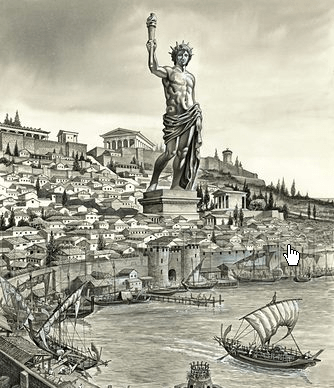
S: Okay, so if what she’s donning represents freedom, then does the Columbia Pictures mascot also represent freedom, since again, it’s a torch-bearer with a crown of rays?
T: Columbia is a personification of the United States, just as Britannia is a personification of the United Kingdom.
S: But why was Columbia chosen? Who is Columbia?
T: When the British were defeated in 1783, Columbia was chosen as an icon to galvanize the spirit of the Manifest Destiny. Her light was meant to illuminate the unknown western expanse, which is why her statue almost always faces west.
And so, we have our official answers.
But the inquisitive student is still left with so many questions swimming around in his head. For example, since Columbia is a personification of the United States, is that why our capital is called the “District of Columbia”? Why isn’t Columbia mentioned in textbooks? What’s the connection to Christopher Columbus, if any? And if a connection does exist, why didn’t we name it the “District of Columbus”? Why is she such a mystery but her name is used by so many companies and organizations, such as Columbia Records, Columbia Sportswear, Columbia Pictures, and Columbia University? Do they know something we common citizens don’t?
Many statues of Columbia have been erected at and around the capital, and she’s often seen wearing a rayed crown, carrying a 5-petalled flower or a 5-pointed star, and wielding a sword or a torch. Sometimes, she carries two torches like the goddess Hecate. She also sometimes has the wings of a dove and is surrounded by mermaids or people with fish-like features. She’s sometimes depicted in a dress made of scales, or is covered in scales herself. Columbia can also be found at the entrances of many courthouse buildings across the nation, and there are often icons of shells and stars flanking her nearby. Finally, sometimes the 5-pointed star appears to be blazing, or appears affixed to her crown.

The Columbine flower is a 5-petalled flower, named such because it looks like five doves drinking from the blossom. This is the very same flower Columbia so often holds in her depictions.
“Columba” is a female dove, and is also the name of the dove constellation in the night sky. What does all this have to do with the U.S.? Well, the western world was discovered by Columbus, which is Latin for “a male dove”, which comes from the Greek word kolumbos, which means “to dive or plunge headlong”. Could it be that Columbia was deemed our mascot simply as a nod to Christopher Columbus? And even if it were so, that still doesn’t answer who Columbia is.
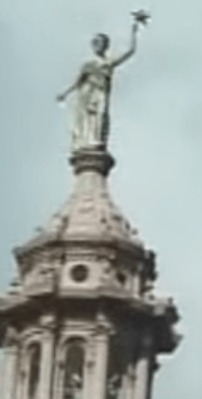
To better understand this mysterious Columbia figure, we have to go back further, back to ancient Babylon. It is said that Nimrod built the Tower of Babil, and that Queen Semiramis, a “motherly warrior goddess”, built the Hanging Gardens of Babylon. Both constructions were wonders of the ancient world, just as was the Colossus of Rhodes. And they helped King Nebuchadnezzar II, the “great king of Babylon”, cement his place as the most powerful man in the world. Also note that, according to legend, Semiramis’ mother was a mermaid.
Legend also has it that King Nebuchadnezzar II was destroyed by the “Shekinah”, a female inversion of God. (You’ll soon see androgyny will be a common theme here.) It is believed the convergence of light between the planets Mercury and Venus symbolizes a “time of greatness”, and is often depicted as a distant sunrise on the horizon. This convergence of light also happens to be called shekinah, and some even believe this is the very same light that the three wise men followed to locate the baby Jesus.
Something seemed fishy to me when I traveled with my wife to Japan some years ago. We visited the island of Odaiba (which was a wonderful place), and there, in all its glory, stood the Statue of Liberty. Like most U.S. citizens, I knew of the one in New York Harbor and the “other one” in Las Vegas. Seeing a third one in Japan messed with my brain a bit, but I figured the people in Tokyo love U.S. culture so much, they must’ve decided to have a replica built as an attraction, much like how they rebuilt the Eiffel Tower and rechristened it as “Tokyo Tower”. (This goes to show how much of an information bubble U.S. citizens like myself have been living in.)
Then I learned that the original statue actually stands in Paris, in Jardin du Luxenbourg. There’s another nearby, on an island in the River Seine. The statue in New York Harbor, the one the Ghostbusters famously piloted, is itself a replica. I later learned there are nearly 100 “Statues of Liberty” worldwide, such as in South America, Asia, and Australia. The statue that so many U.S. citizens think is one-of-a-kind statue representing freedom and is “as American as apple pie” isn’t, it turns out, so they understandably receive some culture shock when they first see the statue during their travels abroad.
If the inquisitive student were to continue down this little rabbit hole, he would eventually stumble upon the following:
- The Statue of Liberty isn’t even called the “Statue of Liberty”. It’s called “Liberty Enlightening the World”.
- It was originally created for Egypt and meant to stand at Port Said in the Suez Canal. It was called “Progress Carrying the Light to Asia”.
- The proposal was turned down by Isma’il Pasha, the Khedive of both Egypt and Sudan, who, due to cost concerns, favored a different lighthouse design instead.
- The statue was not given to the United States by the French government, and was certainly not a gift of peace between nations. It was brokered through clandestine means.
- So it should come as no surprise, then, that Frederic Auguste Bartholdi (the sculptor and co-designer), Gustave Eiffel (the inner-structure designer), and Richard Hunt (pedestal designer) were all deeply affiliated with secret societies.
- As the original thirteen colonies expanded, “Columbia” served as an informal placeholder for the nation’s name before it became the “United States of America”, allegedly named in honor of Christopher Columbus. Others say that it was due to a large population of doves that were found in the new world. Either of these explanations at least help explain the “District of Columbia”.
- Columbia carries a “Sword of Justice”.
- She represents feminine ideals and, by the admission of Bartholdi himself, is a conglomerate of many goddesses.
- She holds the “Torch of Prometheus” high in the sky, ablaze with the light of wisdom, holding it aloft so that only the elite may basque in it and be enlightened. It is a symbol of forbidden knowledge, and, believe it or not, Lucifer. It is alternatively known as the “Torch of Enlightenment”.
- Prometheus stole the divine fire from the gods and gave it to the mortals, thus the “enlightened” believe they were given Heaven on Earth. This is where the phrase “As above, so below” comes from. Their ultimate goal is, of course, immortality. Prometheus is celebrated by the occult because he stole enlightenment from above, and Prometheus was stricken down from the heavens by Zeus with a lightning bolt. (Prometheus and Lucifer are consequently symbolized by a lightning bolt striking the ground from the heavens. The comic book Promethea, as you may have guessed by now, is about a gender-swapped Prometheus).
- Columbia wears a “cloak of night” to hide the secret light of wisdom, which is why the robe is covering her body, to hide “enlightenment” from the unworthy.
- The seven rays do not represent the seven continents and seven seas, but the seven liberal arts and sciences, since all the personifications of the liberal arts are female. This is why Columbia University in New York was named as such. The 1893 Columbian Exposition was held in Chicago, where a twenty-four foot gilded sculpture of Columbia was commissioned which still stands in the center of Jackson Park to this day. Chicago also has a Columbia College, also named after the goddess. The rays can represent the “seven rays of creation”, or the spirit radiating from the mind. It has similar meaning on the god Helios, who is often depicted as an “all-seeing eye”.
- The tablets she carries are “tabula ansata”. Dove-tailed tablets, returning to the theme of doves. Anything written on them are meant for the public eye and sent up like a magical prayer as an offering. The date of the Declaration of Independence is tacked onto her tabula ansata, but this obviously wasn’t the case when the statue was originally presented to Egypt. In another timeline, the tablets could have displayed Egyptian writing instead.
- Columbia is almost always depicted as a beautiful female. However, the proportions of the Lady Liberty’s face are mathematically male, as a trained artist such as Bartholdi would have known. There are no pictures of Bartholdi’s mother, and the idea that the statue was modeled after his mother was only an unsubstantiated rumor started in France. It’s quite possible this is one reason the figure is completely shrouded in robes, as the gender could indeed be one of “her” secrets.
- Until 1931, the U.S.’s de-facto national anthem was “Hail, Columbia”.
- The poet that wrote “The New Colossus” (Emma Lazarus) also wrote poems specifically about Babylon.
- Columbia is the goddess of magic, which is why she carries the “blazing star” or “golden star”, a pentagram. The shape of the pentagram matches the path traced by the planet Venus over the course of every eight years when viewed from the Earth. Venus is often referred to as the “morningstar”, so of course the star, just like the torch, represents Lucifer. And it would not be incorrect to say Lucifer and Venus are one and the same.
- Her “Lady Justice” form wears a blindfold, and is a derivative of the Egyptian goddesses Isis and Maat, both of whom also held the Scales of Justice. “Justicia”, the goddess of justice in Roman mythology is the predecessor for Lady Justice and is likewise is a derivative of Isis and Maat.
- Columbia is known as the “Virgin of the World”, which is why she is sometimes portrayed with the purity of a dove.
- She is also known as the “Mother of Harlots” which is why she is sometimes portrayed as a fallen angel.
- The platform Lady Liberty stands on was designed to look like the eighth gate of Babylon, the “Ishtar Gate”.
- Though bearing a different name, Columbia is the very same goddess as Semiramis, Ishtar, Innana, Astarte, Kali, Freya, Minerva, and Isis. They are all one and the same. It would not at all be incorrect to say that “Liberty Enlightening the World” is a depiction of the goddess Isis.
- This goddess is also sometimes portrayed as an owl, because owls are wise and therefore illuminated, and their eyes can see the secrets of the night. Consequently, owls are used as a symbol for silence and keeping secrets.
So, as you can see, silence really is a rabbit hole.
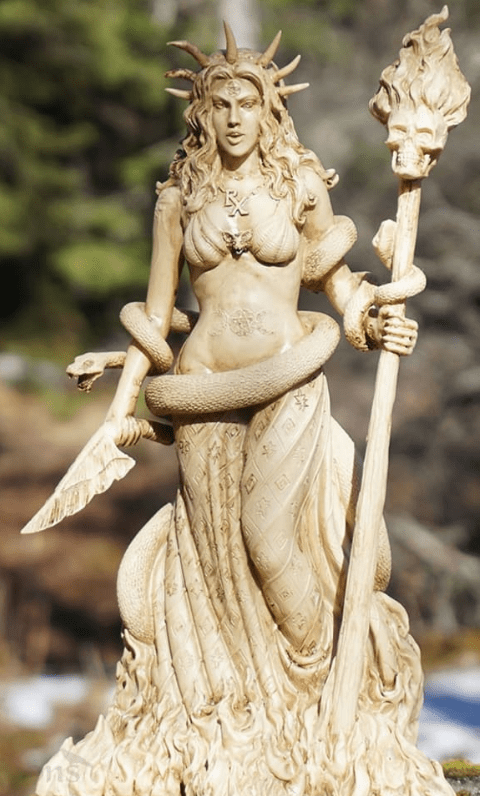
If you didn’t know most of the above information–which I can’t blame you if you didn’t–I’m afraid that Lady Liberty’s light wasn’t meant for you. It wasn’t meant for me, either. I’m down here by her sandled feet with the rest of you.
And, well, there you have it. Babylon still holds sway over the culture of all nations. It’s “baked into the cake”, one might say. Or at least, the people in the highest positions of power are trying to ensure it stays that way. Now, this stuff may not interest you. But you need to understand that most of the celebrated writers and artists involved in the entertainment industry–and especially their bosses–DO know this kind of stuff, and seem to believe it is important to include in art.
Thanks for bearing with me though this deep dive. It’s a lot to take in, but we’re now well on our way to dissecting the meaning hidden within that comic panel.
 Nick Enlowe
12 thoughts on “Unraveling the Many Secrets of the Statue of Liberty”