I realize this movie may not be fresh in everyone’s minds, so let’s do a recap. Then we’ll bring it all together for a final analysis.
THE BEGINNING
Depending on which version of the film you’re viewing, you’re either going to be treated to a Klaus Doldinger orchestral piece (original German theatrical cut), some Giorgio Moroder techno, or the theme song by Limahl.
Either way, the main character–eight year-old Bastian–wakes up to a somber realization. He’s lost his mother; She’s really gone. To cope, he’s been doubling down, trying to escape reality by reading and drawing more than ever.
Now he’s being raised solely by his mundane business-centric father, who’s trying to put a stop to Bastian’s nonsense. After all, his son’s grades have been falling, he failed to join any sports or extra-curricular activities, and he’s been showing up late to school. Bastian’s math teacher even claims he’s been doodling instead of paying attention in math class.
So we already have a theme: Conformity vs. Creativity.
While his mother likely nurtured Bastian’s creativity, his father sees it as a problem that must be stamped out in order to “move on”. He believes his son’s overactive imagination prevents Bastian from not only getting over her tragic death, but prevents him from growing up and taking responsibility for his life.
“Now Bastian, you’re old enough to get your head down out of the clouds. Stop daydreaming.”
If you watched this film as a child, you probably wouldn’t have realized Bastian’s father is working through the stages of grief in his own way, hiding his pain from his son to seem strong, while raising him the best way he knows how.
It’s clear the father cares for his son, but narratively he represents conformity with the mundane world. Following the death of his mother, the pressures of the mundane are mounting and have surrounded Bastian from all sides. But he’s only eight years old and doesn’t want to face the reality of his loss. He’s not ready to give in. At least, not yet.
BULLIES
Kids who keep to themselves and constantly daydream are prime targets for bullies. So naturally, Bastian is bullied on his way to school. We’re talking about an inner-city kid who has to walk to school on his own through a busy downtown district. (Perhaps the father thinks it will toughen him up.)
Modern Lens: There are those who analyze this movie through a Modern Lens and say it has a “clear anti-bullying message”. But that’s not necessarily true. Bullies are a normal and necessary part of society, unpleasant as they may be. And they’re also a necessary and age-old part of storytelling. Bullies can be a metaphor for anything holding you back in life. P.S.: If you try to “erase” bullying, it will always manifest itself in other forms.
The bullies serve a similar societal function to his father in Bastian’s life. Bullying will either wake up daydreamers and better prepare them for the tough road ahead or it will stomp them down for good, forever realizing their place in society.
Either way, Bastian’s likely to grow up too fast because he’s going to have to deal with them on his own.
They heave him into a dumpster, foreshadowing Bastian’s potential future. On his current path, he could very well one day become a loser, a nobody who drinks himself to death if he can’t overcome what’s been holding him back.
Narratively, this helps the audience feel sorry for Bastian whom we greatly sympathize with since we understand he’s been struggling with one of the greatest losses a child can go through. Dealing with bullies on top of that just makes things worse.
But Bastian doesn’t tolerate this treatment for long. He wastes no time getting himself out of the dumpster.
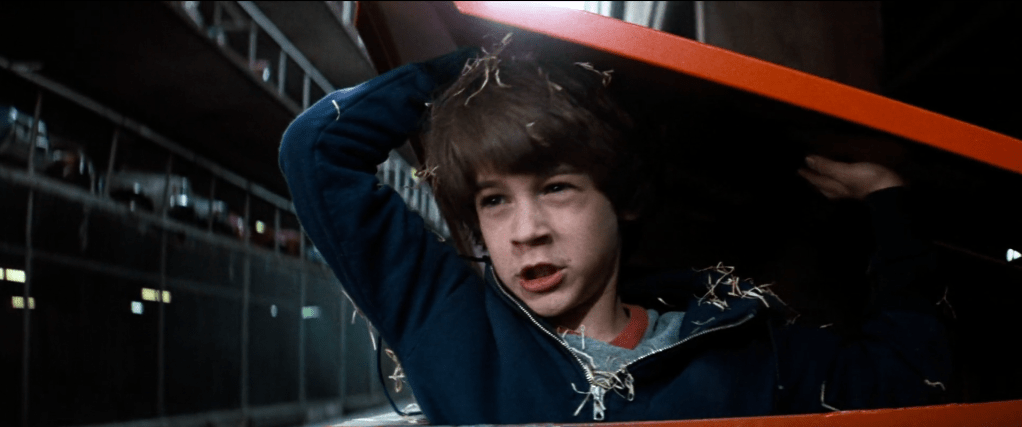
When the bullies notice and try to put him back in, he escapes.
Bastian knows he doesn’t belong in the trash. He wants to aim higher in life. Perhaps he’s got what it takes to overcome these bullies, avoid his bad future, and pull himself out of his own depression.
KOREANDER’S BOOKS
He retreats to a dusty bookstore, escaping his pursuer.
The owner, Koreander, jeers when Bastian arrives, complaining that children don’t seem to care about books anymore. But he’s quite taken by Bastian when he realizes the boy is not only well-read, but would much rather read than play the quarter-munchers at the arcade just down the street.
Koreander says something odd: He tells Bastian there’s no risk in simply reading a book. Sure, you can imagine yourself as the main character, but when it’s all done, you’re just you again.
Bastian says, “But that’s what I like about ’em.”
The old man presses Bastian, asking if he’s ever felt like he might be in actual danger while reading a story. If there’s any real risk.
Bastian shrugs and replies, “It’s only a story,” to the disappointment of the old man.
Koreander was trying to clue the boy in on the nature of consumerism vs. creating something. And he knows that stories are more than just stories. When written with passion, they become powerful forces that can change the world.
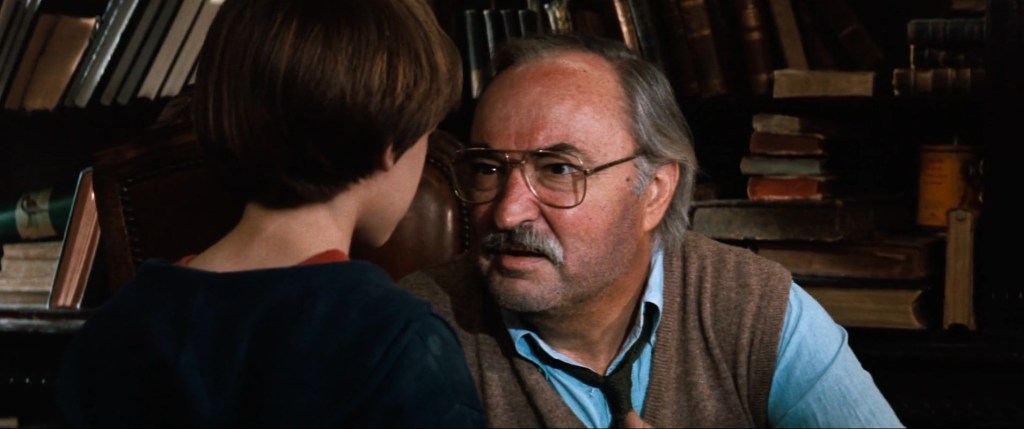
Still, the owner persists. He insinuates he has a special book; a book that’s risky, dangerous. But he doesn’t see enough potential in Bastian and tells him, “Forget about it. This book is not for you.”
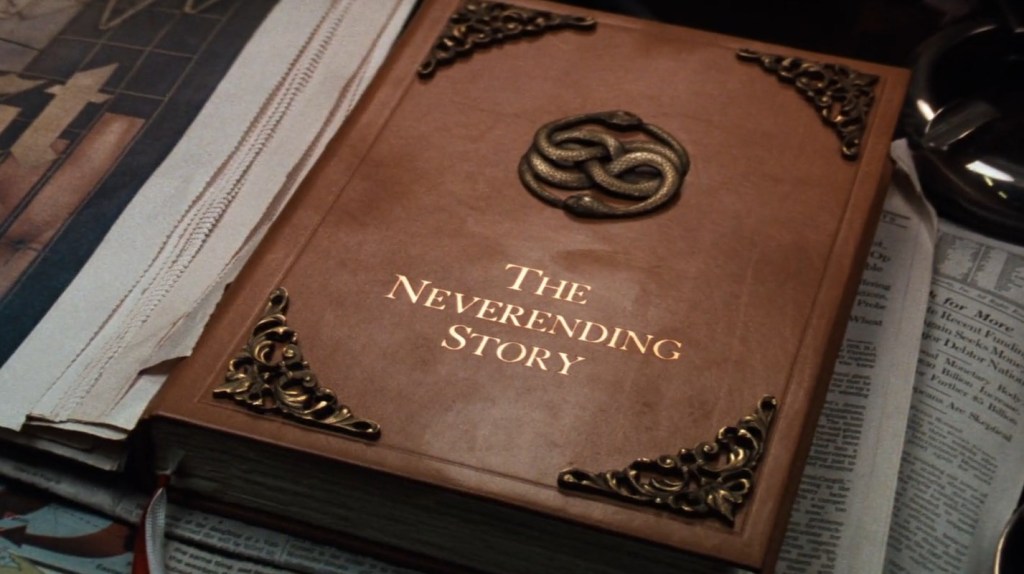
The book sits, tantalizing the boy with its gold lettering and ouroboros infinity emblem begging the question: What kind of book is infinite in nature?
Of course Bastian is intrigued by the prospect of this book, and that’s by design. The old man is secretly trying to awaken the creativity within Bastian through negative reinforcement, as evidenced by his sly smile when Bastian snatches the book and runs off. But not before leaving a message: “Don’t worry. I’ll return your book.”
Interesting point: Koreander covered the book with a mundane newspaper, so it’s up to Bastian to both physically and symbolically move aside the mundane in order to choose the fantastic.
(If you’re a struggling creator, you need to feel as intrigued as Bastian did and snag that book, too!)
Modern Lens: Some like to accuse Bastian of being a bad person because he stole the book. But, first of all, the owner of the store laid it on thick, practically begging Bastian to take it, and Bastian picked up on that fact. He was just told to take risks. Second, back then we had a high trust society and unified culture. There’s no doubt Bastian would’ve absolutely returned the book as if he were just borrowing from a library.
Leaving the message is proof enough he has a good heart.
THE SCHOOL AND ITS ATTIC
At any rate, Bastian smuggles the book away to school, an institutional, ill-repaired, sanitized nightmare covered in low effort, identical student art. He discovers, peering through a thin, prison-like window slit into his classroom, that class is already in session and they’re taking a math test he’s not prepared for.
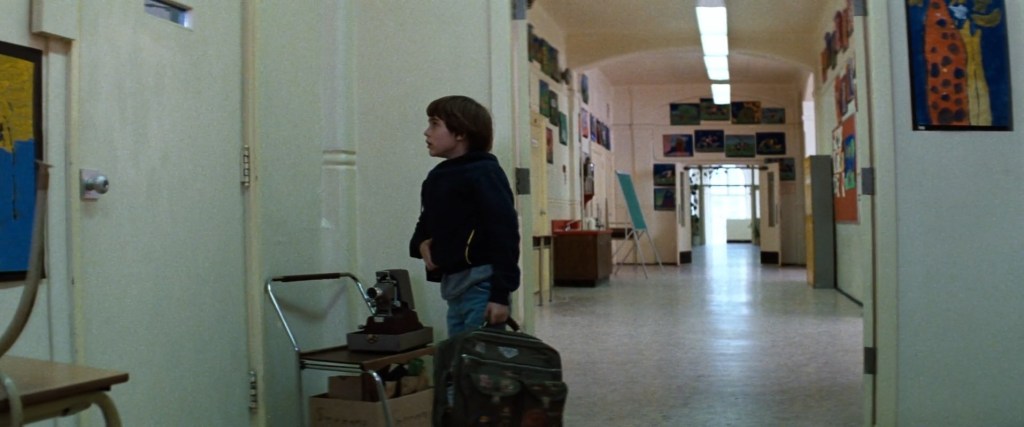
Bastian lives in a world of almost militant consumerism and conformity, a world where children are expected to fall in line and follow instructions rather than be creative. And this was absolutely true in public grade school institutions in the 1980s. Students were being trained to fall in line. And if teachers couldn’t quash out individualism through punishment, they’d do it through Ritalin. Especially if you were a boy.
But Bastian doesn’t belong with these students, taking a math test in a neat orderly line. He’s not like his father, who has conformed. He’s not like the bullies, who try to get others to conform.
Instead, he unlocks a door using unguarded custodial keys and heads up rickety stairs to the forgotten school attic. Thanks to this book, he’s escaped the mundane world and is forging his own path. For maybe the first time since his mother’s death, his mind isn’t focused on overwhelming grief.
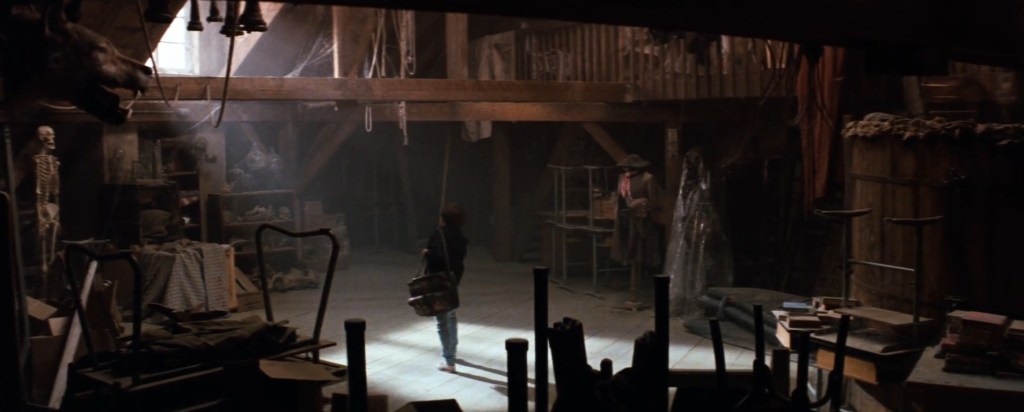
In contrast to the sanitized main school floor, the attic is a wonderous place where imagination can come alive. It’s a belfry with a clutter of secrets untold, rickety balconies with shadowy corners, old forgotten tomes, costumes on busts that seem possessed by ghosts, and light cutting through from above like rays of hope. These are relics from a time when creativity was still encouraged.
It is here where Bastian will finally settle in and start reading.
 Nick Enlowe
3 thoughts on “How The Neverending Story inspired me to write: Part 2”