
The moment Atreyu’s name is mentioned, it sparks a memory within Bastian. He looks at an image stitched onto his backpack: that of an Indian brave hunting a buffalo on horseback. This warrior’s name is also Atreyu; At this point he’s ready to chalk it up to coincidence.

But something interesting happened here: The book broke the fourth wall with Bastian, hinting that something more is going on under the hood of this narrative.
I don’t want to muddy the waters too much, but here’s where we really start to see a divergence between the story the movie is trying to tell and the story contained within Michael Ende’s novel. We’ll have to analyze what happens next through both points-of-view.
THE WARRIOR OF ALL
The Empress’ retainer, “Carion”, describes Atreyu’s people as “hunters of the purple buffalo”, a line which I remember elicited a few chuckles from theatergoers when I saw it as a young child.
Most would chalk this silly line up to children’s book whimsy, and frankly some of Ende’s artistic decisions make it more challenging to take this movie seriously.
Book vs. Movie: In the book, the plainspeople have green skin and blue hair. Otherwise, the culture is directly comparable to the tribesmen of the North American plains.
The crew tried green paint and hair dye tests on actor Noah Hathaway, but it looked ridiculous.
And they thankfully moved on without it, I’m sure to Michael Ende’s chagrin.
Occult Lens: The name Atreyu means “son of all”, a name invented by Ende for this book, though it has sanskrit origins and was likely originally derived from “Atreus”, a fearless warrior king of Greek mythology.
Buffalos are also quite symbolic in esoterica, representing strength and spiritual journeys, and purple almost certainly represents the etheric realm.
I won’t spend too much time on it, but I should probably now mention the fact that author Michael Ende was an Anthroposophist, a horrible spinoff of Theosophy that marries Hermetic Qabalah to an unhealthy blend of heretical Christian beliefs and German Idealism, such as the idea that there were two Jesuses instead of one. And his novel’s story structure is based upon these beliefs.
Modern Lens: Some hipsters get offended due to the “cultural appropriation” with the Atreyu character. It’s known Noah Hathaway was sent to a tanning booth to make his skin darker for the role after the green paint experiments failed.
But Noah played Atreyu with passion and turned in a beloved performance like few child actors could, and Ende himself confirmed that while the two cultures contain similarities, they should not be considered the same. Not to mention most American Indians are not offended and seem to enjoy this movie just as much as the rest of us.
Back to the story…
When Atreyu, a young boy about Bastian’s age, approaches the retainer, the retainer dismisses him for being a mere child. The crowd laughs, but Atreyu insists he possesses the bravery necessary to do what needs to be done.

Carion informs Atreyu of the quest expected of him. He must find a cure for the Empress and save Fantasia. But he must first leave all his weapons behind.
After swallowing the nervousness at the back of his throat, Atreyu lays down his weapons, indicating that he accepts the quest.
Modern Lens: Folks think it’s bizarre that Atreyu is asked to lay down his weapons before going on such a dangerous quest. Since the world itself is at stake, why would Carion want to make it harder on the boy?
But, first of all, Atreyu is on a quest to defeat nothing. One cannot defeat nothing with weapons.
And second, this quest is symbolic of a vision quest, an American Indian rite of passage practiced by many tribes. In order for a boy to become a man, he must go into the wilderness alone and fast until he receives a vision that will guide him toward his purpose in life.
Occult Lens: Third, according to Anthroposophy teachings, the quest for esoteric knowledge must be gained “alone and unarmed”.
AURYN: THE DOUBLE OUROBOROS
It is then that Carion gives Atreyu a medallion called the “Auryn”.
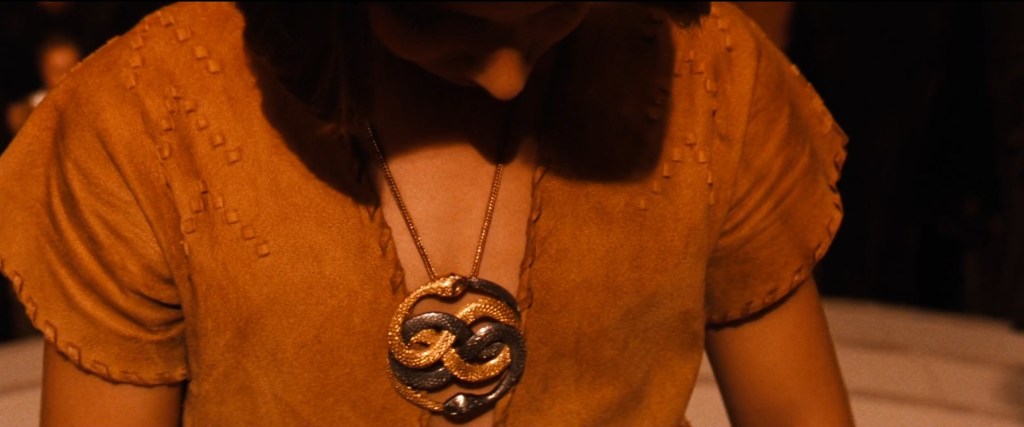
Bastian recognizes this medallion immediately as the same emblem on the cover of Koreander’s book, the twin ouroboros snakes eating their tails.
Occult Lens: This symbol is called a double ouroboros, and represents a concept in Anthrosophosy where your upper and lower natures are in “infinite balance”. In Ende’s book, the phrase, “Do what you wish” is inscribed on the Auryn, which is a bit too close to “Do as thou wilt,” for comfort.
Carion explains this symbol allows Atreyu to speak on behalf of the Empress, and that it will guide and protect him.
With no further direction given, Atreyu takes off from the Ivory Tower atop his beautiful white horse, Artax. Heading off in a random direction may seem reckless, but…
Book vs. Movie: …in the book, it’s made clear that if you set off on a journey through Fantasia, you’ll end up where your heart most desires.
None-the-less, after a week of travelling, Atreyu has uncovered no leads on a cure for the Empress, and each day The Nothing is grows stronger. But his spirits are high. He hasn’t lost hope.
And here it’s revealed a “creature of darkness”, a wolf-like beast named G’mork has been diligently tracking them down.
None-the-wiser, Atreyu and Artax forge on through the Silver Mountains, the Desert of Shattered Hopes, and the Crystal Towers. And finally, they reach the now infamous “Swamp of Sadness”.
 Nick Enlowe
One thought on “How The Neverending Story inspired me to write: Part 4”